| Journal of Food Bioactives, ISSN 2637-8752 print, 2637-8779 online |
| Journal website www.isnff-jfb.com |
Original Research
Volume 35, September 2026, pages 81-89
Effects of egg white hydrolysate on facial swelling: a randomized, double-blind, placebo-controlled, crossover trial
Aoi Tamuraa, Utano Nakamuraa, Saki Shirakoa, Tsuyoshi Takarab, Yusuke Yamashitaa, Kenji Satoa, Young-il Kima, *
aR&D Division, Pharma Foods International Co., Ltd., 1-49 Goryo-Ohara, Nishikyo-ku Kyoto, 615 8245, Japan
bMedical Corporation Seishinkai, Takara Clinic, Taisei Bldg. 9F, 2-3-2 Higashigotanda, Shinagawa-ku, Tokyo 141 0022, Japan
*Corresponding author: Young-il Kim, R&D Division, Pharma Foods International Co., Ltd., 1-49 Goryo-Ohara, Nishikyo-ku, Kyoto, 615 8245, Japan. E-mail: youngil-kim@pharmafoods.co.jp
DOI: 10.26599/JFB.2026.95035458
Received: July 30, 2026
Revised received & accepted: September 7, 2026
| Abstract | ▴Top |
This study evaluated whether egg white hydrolysate (EWH) reduces morning facial swelling in healthy adults who routinely experience this condition (UMIN000057170). Seventy-six participants were randomly assigned to an EWH-first or placebo-first sequence in a double-blind, placebo-controlled, crossover trial. Participants ingested 250 mg of EWH or placebo once daily before bedtime for one week, separated by a 2-week washout. The primary outcome was the morning Visual Analogue Scale (VAS) score for facial swelling after 1-week intervention. Secondary outcomes included other subjective swelling and coldness sensations, and calf and ankle circumferences. A total of 61 participants were included in the final analysis. EWH intake significantly reduced the VAS score for morning facial swelling compared with placebo after one week (VAS: 54.8 ± 2.6 vs. 58.8 ± 2.6; P = 0.037). Therefore, EWH has the potential to serve as a functional food ingredient that reduces transient facial swelling and improves quality of life in healthy adults.
Keywords: Peptide; Egg white; Swelling; Edema; Clinical trial
| 1. Introduction | ▴Top |
Edema, defined as swelling caused by an accumulation of extracellular fluid, can be broadly categorized into generalized edema and localized edema. Generalized edema affects the entire body or large regions and is typically associated with systemic abnormalities such as cardiovascular, renal, hepatic, or hormonal dysfunction. In contrast, localized edema is confined to specific areas and commonly arises from a disruption of microcirculation and fluid homeostasis, such as increased vascular permeability, inflammation, impaired lymphatic drainage or temperature-related vascular responses. Examples of localized edema include chilblains, insect bites, sprains, allergic reactions, and lymphedema. Morning swelling of the face and neck in otherwise healthy individuals also represents a form of localized and transient edema, characterized by temporary fluid accumulation that resolves spontaneously after waking.
The primary mechanism of morning facial swelling is a postural fluid shift driven by gravity during sleep; venous pressure becomes more uniform in the supine position, interstitial fluid redistributes toward the face and neck, and lymphatic drainage decreases (Tsukahara et al., 2004). Conversely, upright activity during the daytime increases venous pressure in the lower limbs due to gravity, making calf and ankle swelling more prominent in the evening (Mortimer, 1995). Previous studies have also demonstrated clear diurnal variations in swelling and skin thickness; skin thickness significantly decreases from morning to afternoon in the face, forearm, and upper arm, whereas they significantly increase in the thigh and calf (Jogamoto and Hato, 2019; Tsukahara et al., 2001).
However, not all individuals experience this symptom, indicating substantial individual difference in susceptibility. Women are particularly prone to swelling due to estrogen-mediated water retention, while other factors such as microinflammation, reduced lymphatic flow, cold sensitivity, and dietary factors—such as high salt or alcohol intake—can further exacerbate the condition (Ely et al., 2006; Jogamoto and Hato, 2019). In addition to the physical sensation of swelling itself, the accompanying heaviness and discomfort can trigger negative emotions and potentially reduce overall quality of life (QOL) (Cooper, 2018). These facts highlight the need for interventions that improve microcirculation and fluid homeostasis, thereby enhancing daily comfort and well-being in susceptible individuals.
Previous studies examining the alleviation of facial or lower-leg swelling have used polyphenol-rich ingredients such as lemon-derived hesperidin (Nakamura et al., 2019) and French maritime pine bark extract (Cesarone et al., 2005), which contain various polyphenols like flavonoids and phenolic acids. However, the bioavailability of polyphenols is highly dependent on the intestinal environment, as their health benefits rely on metabolic transformation by the gut microbiota. (Li et al., 2025; Marín et al., 2015). Food-derived peptides produced by enzymatic hydrolysis of proteins can also exert diverse beneficial functions in humans. Although most ingested peptides are degraded into amino acids during digestion in the small intestine, recent research has highlighted that certain food-derived peptides are absorbed as bioactive peptides (Matsui, 2018; Sato, 2022).
Egg white hydrolysate (EWH; Runpep®, Pharma Foods International, Kyoto, Japan) is a peptide mixture, which is produced from a by-product of food manufacturing such as mayonnaise industry. EWH has been reported to have antihypertensive activity and to improve peripheral blood flow in animal models (Sakashita, 2014). A clinical study further demonstrated that it promotes thoracic blood flow during endurance exercise in healthy adults (Shirato et al., 2008).
Based on anecdotal observations suggesting improvement of facial swelling following EWH intake, this study aimed to evaluate the effects of EWH intake on facial swelling in healthy Japanese adults who routinely experience morning facial swelling.
| 2. Materials and methods | ▴Top |
2.1. Size-exclusion chromatography
The molecular weight distribution of peptides in EWH was analyzed by size-exclusion chromatography (SEC), which was outsourced to Japan Food Research Laboratories (Tokyo, Japan). The SEC was performed using a high-performance liquid chromatography system (LC-20 AD, Shimadzu, Kyoto, Japan) equipped with a TSKgel G2500PWXL column (7.8 mm i.d. × 300 mm, Tosoh, Tokyo, Japan). The mobile phase was 45% acetonitrile solution containing 0.1 % trifluoroacetic acid at a flow rate of 0.5 mL/min. Elution was monitored by UV absorbance at 220 nm. A molecular weight calibration curve was generated using standard peptides and proteins, including cytochrome C (12,327), aprotinin (6,512 Da), bacitracin (1,450 Da), angiotensin II (1,046 Da), Gly-Gly-Tyr-Arg (451 Da), and Gly-Gly-Gly (189 Da).
2.2. Test products
EWH was produced by digesting dried egg white with three types of proteases—Papain 300 (BIOCON Japan, Nagoya, Japan), Protease S Amano G and Protease N Amano (Amano Enzyme, Nagoya, Japan) —and one peptidase Peptidase R (Amano Enzyme).
Test product, tablet containing 125 mg of EWH, was prepared by Aliment Industry (Nambu, Japan). Peptide content in EWH was 76.5% (95.6 mg) based on nitrogen content obtained by the Kjeldahl method. The placebo contained the same ingredients as the test products, except that EWH was replaced with an equivalent amount of microcrystalline cellulose (Table 1). The test products and placebo were indistinguishable in appearance, shape, color, odor, and taste.
 Click to view | Table 1. Composition of test product and placebo per daily intake (mg / 2 tablets / day) |
2.3. Participants
Participants were recruited through “Go-Tohroku” (https://www.go106.jp/), a monitor recruitment website operated by OrthoMedico (Tokyo, Japan). Recruitment was conducted between February and March 2025. None of the participants were affiliated with the study sponsors or the funding organization. A total of 154 candidates were requested to report scores in facial swelling using a visual analogue scale (VAS) “I feel facial swelling” on the morning of the screening examination. Subjective facial swelling was evaluated using the VAS, ranging from 0 mm (“best imaginable state”) to 100 mm (“worst imaginable state”). The target sample size was determined based on an unpublished pilot study performed in Pharmafoods International (Approval No. PF0154) using R (version 4.4.2), which estimated an intervention effect of 10.3 mm on the primary outcome (morning VAS score for facial swelling). Using a pooled standard deviation (SD) of 22.7 and an inter-individual variability index of 1.7, the required sample size was calculated to be 35 participants per sequence to achieve a significant level (α) of 5% and a power (1-β) of 99.9% (total n = 70). To account for potential dropouts, we finally enrolled 38 participants per sequence, resulting in a total of 76 participants (62 females and 14 males) with VAS scores higher than 50 mm.
Eligibility criteria:
Exclusion criteria included:
2.4. Study design
This study was conducted as a randomized, double-blind, placebo-controlled, crossover trial. The study schedule is shown in Table 2. The trial was conducted between May and July 2025. Eligible participants (n=76) were randomly assigned to either EWH-first or placebo-first sequence. The allocation sequence was generated by an independent manager using R (version 4.3.2) with a sex-stratified, and random-block algorithm. To ensure blinding, identification numbers were assigned to the test products by the sponsor, and the allocation codes were kept strictly confidential until study completion. Emergency keys were stored in individually sealed envelopes. All parties, including investigators, medical staffs, and analysts, remained blinded until data fixation and finalization of the statistical analysis plan. The blind was broken only after confirming that all sealed envelopes remained intact.
Click to view | Table 2. Schedule of enrollment, interventions, and assessments throughout the clinical trial |
The study consisted of two 1-week intervention periods (Period I and Period II) separated by a 2-week washout period. The intervention period was set to 1 week as significant improvements were already observed after 1-week intervention in the pilot study. In Period I, participants in the EWH-first sequence consumed test products containing 250 mg of EWH, while those in the placebo-first sequence consumed the placebo for one week. The dosage of EWH was determined based on the effective dose in the pilot study. After a 2-week washout period, participants crossed over to the alternative product for one week in Period II. In both periods, participants were instructed to take two tablets with water or lukewarm water within one hour before bedtime. Participants were instructed to visit either Takara Clinic, Medical Corporation Seishinkai (Tokyo, Japan) or Nerima Medical Association Minami-machi Clinic (Tokyo, Japan) at baseline and at day 8 of Period I and II, where assessments were performed.
This study was approved by the Ethical Committee of the Takara Clinic, Medical Corporation Seishinkai on February 12, 2025 (Approval Number: 2502-02351-0123-2A-TC). Subsequently, the study was registered with the University Hospital Medical Information Network Clinical Trials Registry (UMIN-CTR) on February 28, 2025, under the title “Effects of consumption of the test food on the swelling in healthy Japanese: a randomized, placebo-controlled, double-blind, crossover comparison trial” (Registration Number: UMIN000057170, URL: https://center6.umin.ac.jp/cgi-open-bin/ctr/ctr_view.cgi?recptno=R000065348). The trial was conducted in accordance with the Declaration of Helsinki (revised in 2024) and the Ethical Guidelines for Medical and Health Research Involving Human Subjects, with full consideration given to medical ethics.
2.5. Study outcomes
Outcomes were assessed at baseline and on the final days of intervention Period I and II. Participants were instructed to perform the morning assessment within 60 min of waking up and the evening assessment between 17:00 and 18:00.
For all parameters (unless otherwise specified), statistical comparisons were performed using three metrics after 1-week intervention: (1) raw scores, (2) changes from baseline, and (3) diurnal changes (morning-to-evening differences).
The primary endpoint was defined as the morning raw score after 1-week intervention. Secondary outcomes included as follows:
Participant health was monitored through medical interviews conducted on examination days and a three-day dietary survey using the Calorie and Nutrition Diary prior to each visit. Daily logbooks were used to record test product intake, physical condition, medication use, and lifestyle factors. Adverse events (AEs) were identified and summarized based on interviews and logbooks. In the case of AEs, the principal investigator provided appropriate medical management and determined whether study participation should continue and decided whether emergency unblinding was necessary. The investigator also evaluated and reported the causal relationship between AEs and the test product based on predefined criteria.
2.6. Statistical analysis
Efficacy parameters were measured at baseline and the final days of each period. The change from baseline was calculated for each intervention. Participant demographics for the enrolled and analyzed populations were summarized as means ± SD and compared using Welch’s t-test. Primary and secondary outcomes were analyzed using a general linear mixed model including group (sequence), participants nested within groups, period, and food as fixed factors to evaluate treatment, sequence, and period effects. The definitions of treatment, sequence, and period effects are as reported by Lim and In (2021). Results are presented as means ± SD and estimated marginal means (EMMs) with 95% confidence intervals (95% CIs). All statistical tests were two-sided with a 5% significance level, using SPSS Statistics (version 23). Secondary outcomes were exploratory; thus, no multiplicity adjustments were made.
| 3. Results | ▴Top |
3.1. Molecular weight distribution of peptides in EWH
SEC chromatogram is shown in Figure 1. Most peptides were eluted in the fraction corresponding to a molecular wight less than 6,000 Da. The molecular weight distribution of peptides in EWH is shown in Table 3. Based on peak areas, peptides with molecular weights less than 500 Da and those between 500 and 1,000 Da accounted for 57 % and 18 % of the total peak area, respectively. SEC analysis revealed that EWH predominantly consisted of low molecular weight peptides less than 500 Da.
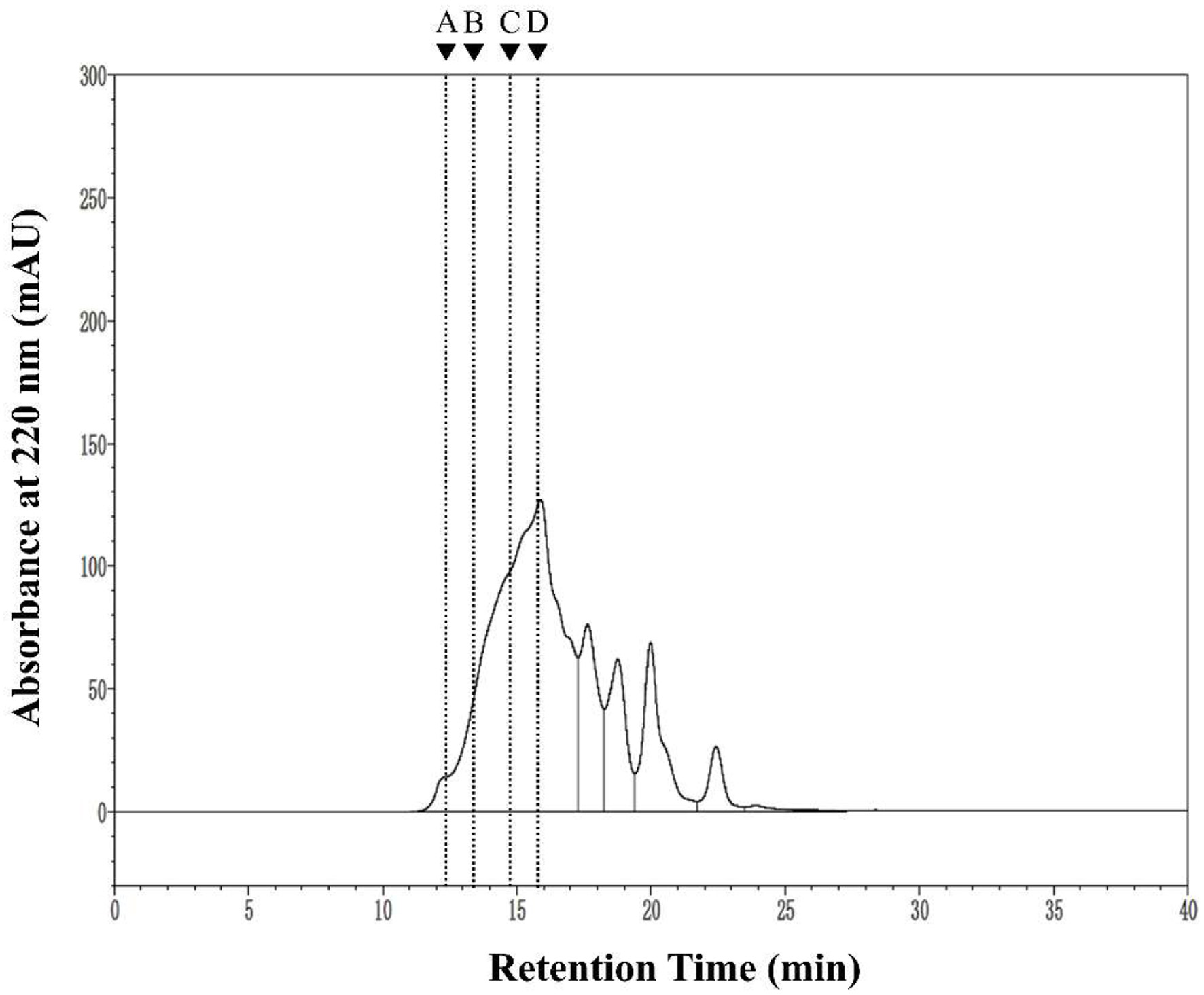 Click for large image | Figure 1. Size-exclusion chromatogram of peptides in EWH. Molecular weights were estimated based on the retention times of standard proteins and peptides. Arrows A, B, C, and D indicate estimated elution position of molecular weights of 6,000, 3,000, 1,000, and 500 Da, respectively. Peak area > 6,000, 3,000–6,000, 1,000–3,000, 500–1,000, < 500 were calculated. |
Click to view | Table 3. Molecular weight distribution of peptides in EWH |
3.2. Participants
As shown in Figure 2, a total of 154 candidates were screened, 76 were enrolled and equally assigned to two sequences. The EWH-first sequence consisted of 38 participants (mean age: 43.4 ± 10.2), and the placebo-first sequence consisted of 38 participants (mean age: 42.5 ± 11.1). During the trial, 15 participants were excluded from the analysis for the following reasons: 5 failed to receive the assigned intervention in Period I, 5 had a compliance rate of less than 80% and 5 violated dietary restrictions by consuming prohibited supplements or blood-flow-enhancing foods. Consequently, the per-protocol-set (PPS) for the final analysis consisted of 61 participants (EWH-first; n = 31 [25 females, 6 males]; placebo-first, n = 30 [23 females, 7 males]). The baseline characteristics of both the enrolled and analyzed participants are summarized in Table 4. No significant differences were observed between the sequences in both the enrolled and analyzed participants regarding age, height, body weight, BMI, systolic blood pressure, diastolic blood pressure, and baseline VAS scores for facial swelling.
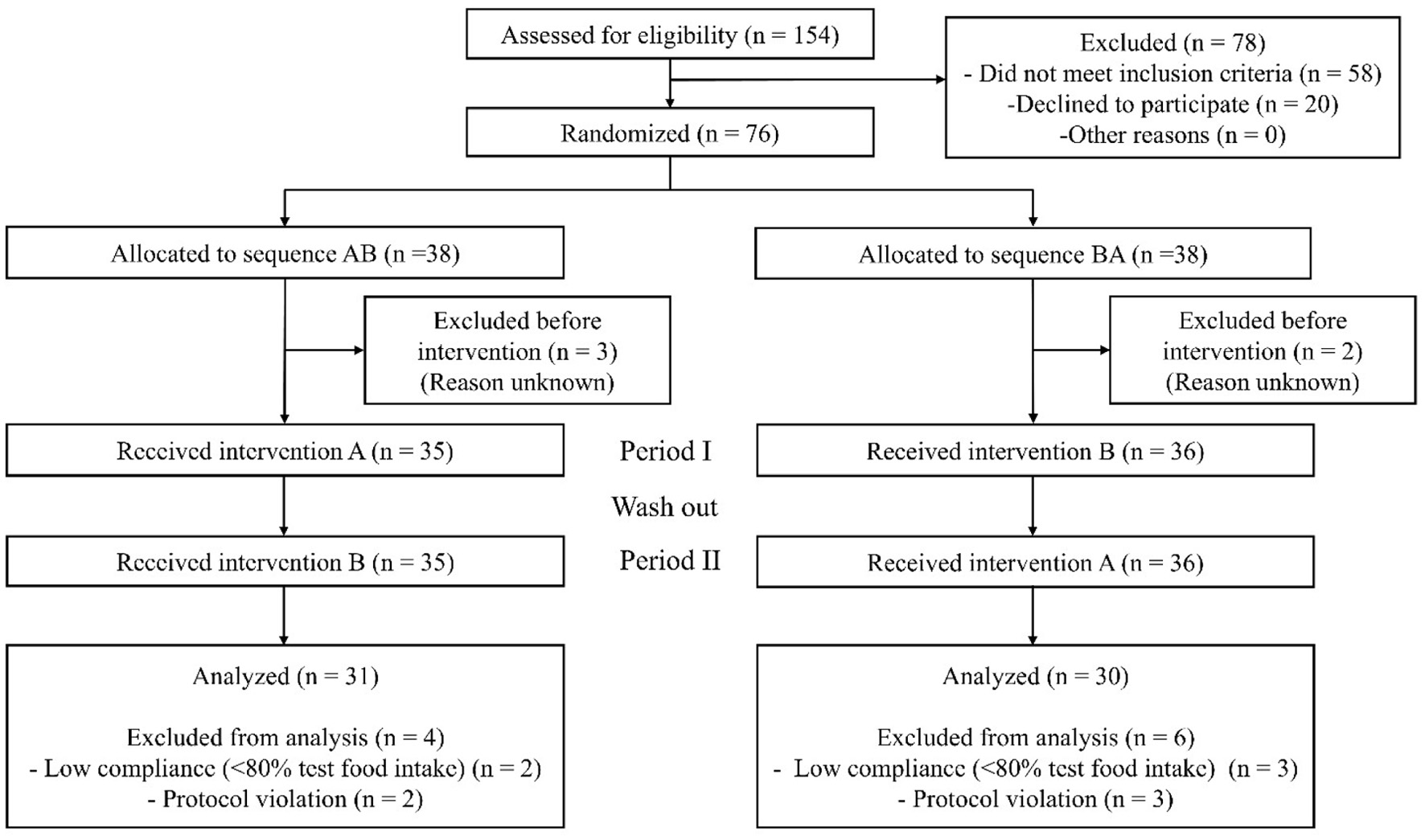 Click for large image | Figure 2. CONSORT flow diagram of participants throughout the study. A = the test product, B = placebo |
Click to view | Table 4. Baseline characteristics of participants |
3.3. Outcomes
Table 5 summarizes the results presented as the mean, SDs, EMMs with standard error (SEs) and 95% CIs, and the inter-group differences (⊿). Regarding the primary outcome, the morning VAS score for facial swelling after 1-week was significantly improved in the EWH period (EMM ± SE: 54.8 ± 2.6) compared with the placebo period (58.8 ± 2.6), with a mean difference of −4.1 (P = 0.037). No significant differences were observed regarding the sequence effect and period effect. While no significant inter-group differences were found for any secondary outcomes (Tables S1–S3), VAS score for swelling around eyes showed a trend toward improvement (P = 0.073) (Table 5).
Click to view | Table 5. Subjective outcomes measured during the AM assessments |
3.4. Safety
The present sample was well tolerated, and no adverse events were observed throughout the study period with the intake of either the placebo or EWH (Table S4).
| 4. Discussion | ▴Top |
This study evaluated whether 1-week daily intake of EWH improves morning facial swelling in healthy Japanese adults who routinely experience this condition. The primary outcome—morning VAS scores for facial swelling on the final days of each period—showed a statistically significant improvement during by intake of the EWH compared to the placebo across both sequences.
Previously, several functional peptides have been reported to exert diverse bioactive activities, including antihypertensive effects and improvement in skin moisture (Jia et al., 2021; Premchanth Jyothi et al., 2023; Ucak et al., 2021). To the best of our knowledge, this is the first study to demonstrate that bioactive peptides can reduce facial swelling in healthy individuals. Notably, EWH shows a clear advantage in terms of its effective dose. Whereas collagen peptide—one of the most studied functional peptides—requires daily intake of approximately 1–10 g to achieve measurable effects (Danessa et al., 2025), EWH exerts efficacy at least 250 mg. This highly practical and sustainable dosage suggests that EWH may serve as a promising ingredient for functional foods aiming at supporting vascular health and improving subject-reported QOL.
Morning facial swelling is primarily caused by hemodynamic changes related to sleep posture, specifically increased venous pressure and decreased lymphatic drainage in the facial region. Therefore, improved microcirculation is considered a plausible mechanism underlying the observed effect. In vitro studies have shown that EWH stimulates nitric oxide (NO) production in endothelial nitric oxide synthase (eNOS) - stably expressing human embryonic kidney 293 cell line (Sakashita, 2014) and in vivo studies have demonstrated increased plantar blood flow in normal rats and thoracic blood flow during endurance exercise in humans after EWH intake (Sakashita, 2014; Shirato et al., 2008). Such NO-dependent circulatory improvement may reduce posture-induced fluid retention observed in the morning.
In addition, vascular permeability is known to increase with inflammation, suggesting that mild, subclinical inflammation may exacerbate morning swelling in some individuals. Low physiological levels of eNOS-derived NO exert anti-inflammatory effects by inhibiting neutrophil adhesion and platelet aggregation, whereas excessive NO produced via inducible nitric oxide synthase (iNOS) during inflammatory states can increase vascular permeability and worsen swelling (Bian et al., 2008; Cyr et al., 2020). Although inflammatory markers were not evaluated in this study, it remains possible that peptides contained in EWH contributed to the improvement in swelling by suppressing mild inflammation that amplifies morning facial swelling.
This study has several limitations. First, the evaluation of facial swelling relied solely on subjective assessments. Because this was the first study to investigate the effects of EWH on morning facial swelling and its efficacy was difficult to predict, objective measurements that could impose additional burden on participants were not implemented. Although significant subjective improvements were observed in this placebo-controlled, double-blind, crossover trial, future studies incorporating quantitative assessments such as 3D facial scanning, ultrasound for skin thickness, tissue hydration meters are needed to elucidate the underlying mechanisms.
Second, this study did not directly measure physiological changes related to the hypothesized mechanism, including NO production and blood flow in the present participants. Therefore, the mechanistic pathways discussed herein remain hypothetical and rely on previous in vitro and in vivo findings without a direct link to the present clinical data. Future studies incorporating relevant biomarkers and hemodynamic measurements are required to establish the causal relationship between EWH intake and swelling reduction.
Third, the study population consisted exclusively of individuals who routinely perceived high levels of morning swelling. Therefore, the effects of EWH in individuals who do not typically experience swelling, as well as the physical or biochemical differences between those who do and do not experience morning swelling, remain unclear and warrant further investigation.
Finally, the specific bioactive peptide sequences for the physiological effects of EWH have not yet been identified. We are currently conducting qualitative and quantitative analyses of peptides absorbed into human bloodstream after EWH ingestion to determine which components contribute to the reduction of facial swelling in vivo.
| 5. Conclusion | ▴Top |
In conclusion, daily intake of EWH for one week was confirmed to alleviate transient facial swelling in the morning among healthy Japanese adults who routinely experience this condition. Furthermore, the test product was found to be safe under the conditions of this study.
| Supplementary Material | ▴Top |
Suppl 1. Objective outcomes measured during the AM assessments.
Suppl 2. Measured values of all outcomes during the PM assessments.
Suppl 3. Diurnal changes in all outcomes between the AM and PM assessments.
Suppl 4. Incidence of adverse events during the study period.
Data availability
The datasets generated and analyzed in this study are available from the corresponding author upon reasonable request.
Institutional review board statement
The study was conducted in accordance with the Declaration of Helsinki (revised in 2024) and approved by the Ethical Committee of the Takara Clinic, Medical Corporation Seishinkai on February 12, 2025 (Approval Number: 2502-02351-0123-2A-TC). Prior to the start of the study, the contents were registered with UMIN-CTR, which is managed by UMIN on February 28, 2025, under the title “Effects of consumption of the test food on the swelling in healthy Japanese: a randomized, placebo-controlled, double-blind, crossover comparison trial” (Registration Number: UMIN000057170,URL:https://center6.umin.ac.jp/cgi-open-bin/ctr/ctr_view.cgi?recptno=R000065348
Informed consent statement
Informed consent was obtained from all participants involved in the study.
Funding
This study was only carried out by the budget of Pharma Foods International (Kyoto, Japan).
Conflict of interest
The six authors (AT, UN, SS, YY, KS and YK) declare potential financial conflicts of interest related to this study. This study was funded by Pharma Foods International, which provided the necessary consumables and may derive financial benefit from the publication of this manuscript. In addition, the author (YK) is the director of Pharma Foods International and holds shares in a company that may have potential financial benefits or losses from the publication of this paper.
| References | ▴Top |