| Journal of Food Bioactives, ISSN 2637-8752 print, 2637-8779 online |
| Journal website www.isnff-jfb.com |
Review
Volume 35, September 2026, pages 24-37
Coreopsis tinctoria and its bioactives in the prevention and management of diabetes and diabetic complications
Wenyu Zhanga, Yixing Zhua, Junfeng Shena, *, Alexander Gosslaub, c, *
aCollege of Biology and Agricultural Resources and Hubei Key Laboratory for EFGIR, Huanggang Normal University, Huanggang, 438000, China
bDepartment of Science, City University of New York, BMCC, 199 Chambers Street, New York, NY 10007, USA
cDepartment of Chemistry and Chemical Biology, Rutgers University, 123 Bevier Road, Piscataway, New Jersey 08854, USA
*Corresponding author: Junfeng Shen, College of Biology and Agricultural Resources and Hubei Key Laboratory for EFGIR, Huanggang Normal University, Huanggang, 438000, China; Alexander Gosslau, Department of Science, City University of New York, BMCC, 199 Chambers Street, New York, NY 10007, USA. E-mail: jfshen@hgnu.edu.cn (JS)and agosslau@bmcc.cuny.edu(AG)
DOI: 10.26599/JFB.2026.95035453
Received: April 25, 2026
Revised received & accepted: July 29, 2026
| Abstract | ▴Top |
Diabetes, one of the major metabolic diseases, has become a major public health concern worldwide leading to chronic lesions in various organs such as kidney and cardiovascular disease, severely impacting quality of life and life expectancy. Current drug treatments for diabetes have varying degrees of side effects. Therefore, finding natural, safe, and effective functional foods to prevent and control diabetes and its complications has become a research hotspot. Coreopsis tinctoria Nutt. (C. tinctoria) is rich in polyphenols (e.g. flavonoids), polysaccharides, and other bioactive components, possessing various health benefits. Studies have shown that C. tinctoria flavonoids lower blood sugar levels through multiple pathways, including suppressing oxidative stress, decreasing the inflammatory cascade, regulating glucose and lipid metabolism, increasing insulin sensitivity and improving insulin resistance. This review briefly summarizes the research progress on diabetes and its complications, and details the mechanisms of action of C. tinctoria bioactives in prevention and treatment of diabetes and its complications. The aim is to provide the molecular mechanisms of C. tinctoria and its bioactives for a potential application of C. tinctoria in controlling diabetes and its complications.
Keywords: Coreopsis tinctoria Nutt.; Diabetes mellitus; Diabetic complications; Oxidative stress; Inflammation
| 1. Introduction | ▴Top |
Diabetes mellitus (DM) is a complex metabolic disorder characterized by chronic hyperglycemia. Its pathogenesis involves defects in insulin secretion, insulin resistance (IR), abnormal hepatic glucose output, impaired glucose uptake in muscle and adipose tissue, and the interaction of genetic and environmental factors (Chaudhury et al., 2017; Lu et al., 2024; Zhao et al., 2026). According to data from the International Diabetes Federation (IDF) in 2025, the number of adults aged between 20–79 years living with diabetes and its pathological conditions has reached approximately 589 million worldwide and is projected to increase substantially over the coming decades. It is estimated that by 2050, the number of people with diabetes worldwide will reach 853 million (IDF diabetes atlas, 2025). Persistent hyperglycemia contributes to progressive structural and functional damage in multiple organs and tissues, including eyes, kidneys, cardiovascular system, peripheral nerves, and blood vessels among others, seriously affecting their quality of life and life expectancy (Galicia-Garcia et al., 2020; Vlassara and Uribarri, 2017; Zhao et al., 2026). At present, the main treatment for diabetes is insulin injection (for type I and advanced diabetes patients) or oral hypoglycemic drugs for type II, but these treatments are accompanied by varying degrees of side effects (Chaudhury et al., 2017; Romero et al., 2017; Lu et al., 2024). Therefore, the search for natural, safe and effective drugs for prevention and treatment of diabetes has become a hot topic in the fields of food science and natural product research. (Donath, 2014; Nanda et al., 2023)
Coreopsis tinctoria Nutt., abbreviated as C. tinctoria, is a plant of the Asteraceae family that originated in the United States and Africa, and is now widely cultivated around the world. Currently in China, C. tinctoria is mainly distributed in the area of Kunlun Mountains at an altitude of about 3,000 meters. It is one of the distinctive alpine wild plants to the Xinjiang Uyghur Autonomous region, China , and is recognized for its unique properties (Guo et al., 2023, 2025). C. tinctoria is rich in flavonoids, polysaccharides, volatile oils, amino acids and other bioactive components. The main functional components of C. tinctoria include essential oils, polyphenols, polysaccharides, amino acids, saponins, and phenylpropanoids among others (Begmatov et al., 2020; Shen et al., 2021; Xu et al., 2021). Polyphenols comprise an important class of bioactives in C. tinctoria, with a total polyphenol content of more than 20% in dry weight (Hayat et al., 2020). Its flavonoids are a major part of polyphenols, mainly including flavones, chalcones, flavonols, dihydroflavones, and isoflavones among others (Guo et al., 2015, 2025; Shen et al., 2021). Among them, the chalcone marein and dihydroflavonoid flavanomarein are the main flavonoid components in C. tinctoria, accounting for more than 50% of the total flavonoid content (Guo et al., 2023; Lam et al., 2016).
Traditionally, C. tinctoria has been used to hypertension, prevent diabetes and other metabolic diseases. Modern pharmacological studies have demonstrated a variety of bioactive activities such as antioxidant, anti-inflammatory, hypoglycemic, lipid-lowering, anti-fibrotic, anti-cancer, anti-ageing, and anti atherosclerosis effects (Du et al., 2026; Guo et al., 2025; Zhu et al., 2026a; Li, et al., 2024; Shen et al., 2021; Sun et al., 2027; Zhang et al., 2023; Zhao et al., 2025b). Accumulating evidence indicates that C. tinctoria may exert beneficial effects against diabetes and its associated complications. (Abdurehman et al., 2026; Ma et al., 2023; Yang et al., 2025; Zhu et al., 2026a, 2026b). It helps maintain glycemic homeostasis and modulate biomarkers related to diabetic complications, potentially through coordinated actions on multiple key target organs and tissues, including the liver, kidneys, pancreatic islets, and vascular endothelium among others (Guo et al., 2022; Liu et al., 2022; Zhang et al., 2022; Yu et al., 2019). Herein, we review the recent studies on the efficacy and mechanism of C. tinctoria in managing diabetes and its complications
| 2. Antidiabetic mechanisms of C. tinctoria and its bioactives | ▴Top |
2.1. Antioxidant and anti-inflammatory effects
2.1.1. C. tinctoria
Oxidative stress is one of the important pathogenic mechanisms of diabetes. When the antioxidant defense mechanism is insufficient, the clearance of reactive oxygen species (ROS) decreases, leading to excessive accumulation of ROS in the body, which in turn stimulates the release of inflammatory cytokines, forming a vicious cycle and exacerbating the pathological process of diabetes (Mehndiratta et al., 2024; Yao et al., 2020; Zamanian et al., 2024; Zhao et al., 2025a). C. tinctoria has exhibited antioxidant activity and can effectively clear excessive reactive oxygen species (ROS) in the body. The DPPH free radical scavenging EC50 capacity of the aqueous extract of C. tinctoria was demonstrated to be 21 μg/mL (Dias et al., 2010). The IC50 values of the DPPH free radical scavenging activity of the alcoholic extract (EEC) and aqueous extract (WEC) of C. tinctoria were 0.298 ± 0.051 and 0.759 ± 0.067 mg/mL, respectively. The ABTS assay, measuring the total antioxidant activity of EEC and WEC was equivalent to 0.268 ± 0.003 and 0.383 ± 0.046 mg/mL of Trolox (Cai et al., 2016). In evaluating the inhibition of lipid peroxidation through the determination of the anti-lipid peroxidation capacity of the linoleic acid system, both n-butanol extract and ethyl acetate extract of C. tinctoria were more effective than ascorbic (Zhang et al., 2019). Marein, flavanomarein, and C. tinctoria extract reduced the levels of malondialdehyde (MDA) and ROS while increasing SOD and GSH-Px activities in the cell supernatant.(Guo et al., 2022; Zhao et al., 2025a). Among them, marein, flavanomarein, C. tinctoria polysaccharides and extracts were most effective to protect against the high glucose-induced damage of HUVEC cells by reducing the expression of VEGF ICAM-1 and MCP-1, and inhibiting the proliferation and migration of vascular endothelial cells (Shen et al., 2021; Zhu et al., 2026a). Gavage administration of 100–400 μg/kg/d C. tinctoria extract to streptozotocin (STZ)-induced diabetic rats was demonstrated to enhance the activity of SOD and Glutathione Peroxidase (GPO) in rat serum leading to a reduction of the content of MDA (Shu et al., 2017a). In another study, a dose of 0.2 g/kg/d, C. tinctoria extracted in water, methanol or ethanol increased GSH and SOD activity and reduced MDA levels. (Zhang et al., 2017).
In a high glucose-induced HUVEC model, a C. tinctoria fraction containing marein, flavanomarein, isochlorogenic acid A, dicaffeoylquinic acids, coreopsin, flavanocorepsin, luteolin-7-O-glucoside, 5, 7, 3′,5′,-tetrahydroxyflavanone-O-hexoside, and other polyphenolic compounds, upregulated IRS-1, Akt, and eNOS expression and increased the levels of p-IRS-1Ser307, p-Akt Ser473, and p-eNOSSer1177, while reducing NOX4, TNF-α, IL-6, sVCAM, sICAM, and NF-κB expression (P < 0.01) (Li et al., 2020). At dosages of 200–600 mg/kg/d, a n-butanol extract of C. tinctoria restored the expression levels of CAT, GSH, GSH-PX, and SOD in STZ-induced hyperglycemic and hyperlipidemic mice (Zhang et al., 2019). In summary, C. tinctoria extract and its monomeric compounds can inhibit excessive ROS accumulation in the body thus playing a role in the prevention and treatment of diabetes and its complications by alleviating oxidative stress (Figure 1).
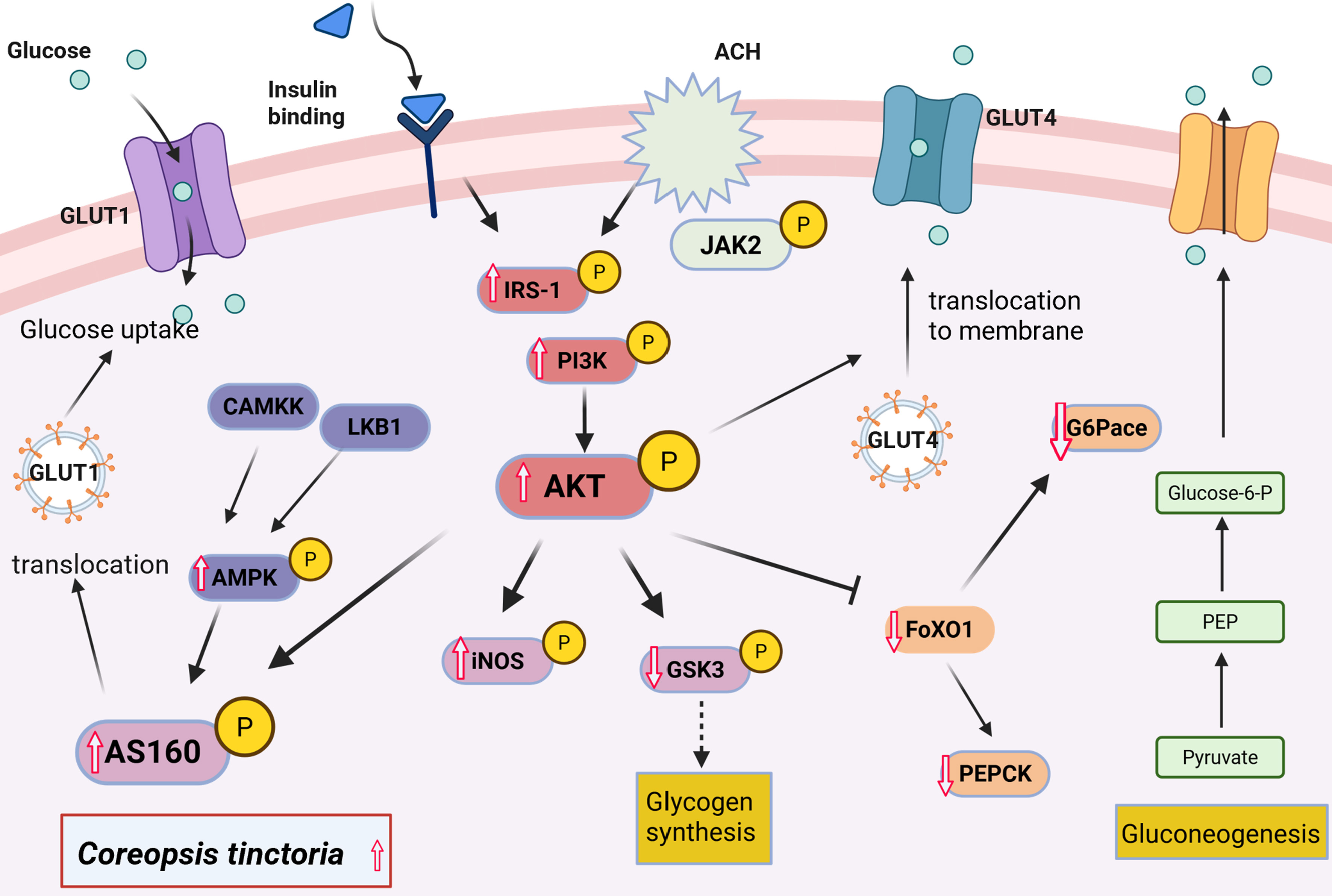 Click for large image | Figure 1. The possible molecular mechanisms of Coreopsis tinctoria leading to an improved diabetic insulin resistance. |
C. tinctoria extracts and marein have demonstrated anti-inflammatory effects in diabetes-associated renal complications, particularly diabetic nephropathy (Yao et al., 2019; Yu et al., 2019). In diabetic rats, C. tinctoria extract attenuated renal inflammation, as evidenced by reduced expression of the inflammatory mediators MCP-1 and ICAM-1, together with suppression of renal injury and fibrosis (Yu et al., 2019). Both C. tinctoria ethyl acetate extract and marein markedly suppressed high-glucose-induced inflammatory responses. Specifically, they reduced NF-κB and NF-κB p65 activation and MCP-1 expression, indicating that inhibition of the NF-κB/MCP-1 axis is an important anti-inflammatory mechanism (Yao et al., 2019).
2.1.2. Marein-mediated antioxidant and anti-inflammatory effects
Marein, a major bioactive flavonoid of Coreopsis tinctoria Nutt., has shown notable anti-inflammatory activity in several experimental models, particularly under hyperglycemic and diabetes-associated pathological conditions. In high-glucose-stimulated rat mesangial HBZY-1 cells, marein attenuated the inflammatory response by suppressing NF-κB signaling and monocyte chemoattractant protein-1 (MCP-1) expression, while simultaneously activating AMPK and inhibiting TGF-β1/Smad signaling (Yao et al., 2019). Pharmacological modulation of NF-κB further supported this mechanism, as marein enhanced the suppression of NF-κB p65 and MCP-1 produced by an NF-κB inhibitor, suggesting that the NF-κB/MCP-1 axis represents an important target underlying its anti-inflammatory action. Because MCP-1 promotes monocyte/macrophage recruitment and activation in diabetic kidneys, its inhibition may contribute to the attenuation of chronic renal inflammation and subsequent fibrotic remodeling. Marein also decreased fibronectin and collagen IV in this model, indicating a close interaction between its anti-inflammatory and antifibrotic activities during diabetic nephropathy (Yao et al., 2019). These cellular findings are supported by in vivo evidence in db/db mice, in which long-term administration of marein ameliorated renal dysfunction, glomerulosclerosis, and ectopic lipid accumulation and, importantly, reduced renal expression of the pro-inflammatory mediators IL-6 and MCP-1 (Guo et al., 2020). Mechanistically, marein directly inhibited renal sodium-glucose cotransporter 2 (SGLT2) and enhanced activation of the AMPK/ACC/PGC-1α pathway, thereby improving glucose/lipid metabolic disturbances in the diabetic kidney. Concomitant decreases in IL-6 and MCP-1, together with reduced fibronectin and collagen I, suggest that the metabolic, anti-inflammatory, and antifibrotic effects of marein are closely interconnected. These findings are particularly relevant because they extend the anti-inflammatory activity of marein from HG-stimulated cell systems to an established animal model of type 2 diabetes and diabetic nephropathy (Guo et al., 2020).
In a high glucose-induced inflammatory injury model, marein inhibited excessive ROS generation and NF-κB activation, along with reduced apoptosis and extracellular matrix degradation in human nucleus pulposus cells exposed to high glucose (Yao et al., 2020). High glucose increased MMP-3 and MMP-13 and decreased collagen II and aggrecan, whereas marein ameliorated these alterations. These observations suggest that suppression of the ROS/NF-κB axis may represent a more general mechanism through which marein protects tissues from chronic hyperglycemia-associated cellular injury (Yao et al., 2020). Additional evidence for a direct anti-inflammatory action of marein comes from the study by Li et al. (2022), in which this investigation employed an LPS-induced inflammatory model. In RAW264.7 macrophage/osteoclast precursor cells, marein dose-dependently suppressed LPS-induced production of TNF-α, IL-1β, PGE2, and COX-2, while reducing RANK, TRAF6, MMP-9, cathepsin K, and carbonic anhydrase II expression. Marein also inhibited phosphorylation of IκBα and activation of NF-κB. More specifically, marein decreased the p-IκBα/IκBα ratio and reduced TNF-α, IL-1β, PGE2, and COX-2, supporting inhibition of IκBα phosphorylation/NF-κB signaling as a key molecular basis for its anti-inflammatory activity. This model has demonstrated the independent mechanistic evidence that marein can directly interfere with NF-κB-mediated inflammatory signaling (Li et al., 2022).
Taken together, existing evidence indicates that NF-κB is one of the most consistently implicated inflammatory signaling pathways targeted by marein, resulting in reduced expression of chemokines, cytokines, and inflammatory enzymes, including MCP-1, IL-6, TNF-α, IL-1β, COX-2, and PGE2. The effects of marein on AMPK activation and ROS suppression may further contribute to the modulation of NF-κB signaling, thereby linking improvements in cellular energy metabolism and oxidative stress with the attenuation of inflammatory responses. In diabetic complications such as nephropathy, this anti-inflammatory activity is closely associated with the inhibition of TGF-β/Smad signaling and extracellular matrix accumulation, which may help attenuate the progression from chronic metabolic stress and inflammation to renal fibrosis. Overall, the available evidence supports marein as an important anti-inflammatory constituent of C. tinctoria, particularly in hyperglycemia-associated renal injury. However, most of the mechanistic evidence remains preclinical, and further studies are needed to clarify its molecular targets, establish pharmacologically relevant exposure levels, and determine its anti-inflammatory efficacy in humans.
2.2. Effects of C. tinctoria and marein on glucose and lipid metabolism
Glucose metabolism disorders are characterized by functional abnormalities in hormonal or enzymatic regulation and pathological changes in tissues and organs involved in glucose, fructose, and other carbohydrate metabolism. (Fadaka et al., 2017). Lipid metabolism disorder refers to the abnormal levels of lipids and their metabolites in the blood and tissues of the body (Galicia-Garcia et al., 2020; Lu et al., 2024). Glucose and lipid metabolism disorder can damage human organs. Therefore, correcting glucose and lipid metabolism disorder is one of the important means of treating diabetes. In recent years, it had been have found that marein increases glucose uptake in high glucose-induced HepG2 cells, and improves hexokinase activity and glycogen synthesis (Jiang et al., 2018). At a dose of 50–100 μmol/L, kaempferol significantly improved glucose consumption impairment caused by palmitic acid treatment in L02 cells leading to normal growth of L02 cells (Huangfu et al., 2024). In rat or mouse models, it has been demonstrated that aqueous and ethyl acetate extracts of C. tinctoria can improve STZ-induced glucose intolerance in rats (Dias et al., 2010; Dias et al., 2010a). In another study, C. tinctoria and Kaempferol significantly decreased body weight and the levels of fasting blood glucose in DIO mice. They also improved glucose tolerance and significantly reduced HbA1c levels, restored gut microbiota balance and significantly increased the abundance of Desulfovibrio and Butyricimonas, which have been associated with improved glucose metabolism and intestinal health. (Zhang et al., 2022). In alloxan-induced diabetic mice, C. tinctoria extract at 0.75–3 g/kg/d reduced blood glucose and glycated serum protein (GSP) levels in a dose-dependent manner, improved glucose tolerance, and reduced the area under the glucose tolerance curve (Fan et al., 2013). Both ethanol extract (0.4–1.6 g/kg/d) and water extract (0.3–1.2 g/kg/d) of C. tinctoria reduced glycated hemoglobin (HbA1c), levels of total cholesterol (TC), triglycerides (TG), and low-density lipoprotein cholesterol (LDL-C) and increased high-density lipoprotein cholesterol (HDL-C) levels in SD rats (Lan et al., 2014). Also an ethyl acetate extract of C. tinctoria (0.15 g/kg/d) effectively reduced random blood glucose and serum TG and LDL levels in diabetic rats (Zhang et al., 2015). Also, the positive effects of ethyl acetate extract of C. tinctoria on lipid metabolism were demonstrated by reduced lipid accumulation in hepatocytes and decreased formation of fat vacuoles in liver slices. (Jiang et al., 2018). Another study showed that the aqueous extract of C. tinctoria (0.1 g/kg/d) significantly increased adiponectin and HDL-C levels in KKAy type 2 diabetic mice (Wu et al., 2017).
Marein improved high glucose-induced insulin resistance in HepG2 cells by promoting glucose uptake through the CaMKK/AMPK/GLUT1 pathway, enhancing glycogen synthesis via the IRS/Akt/GSK-3β pathway, and suppressing gluconeogenesis through the Akt/FoxO1 pathway. Notably, marein significantly increased the phosphorylation of AMP-activated protein kinase (AMPK) and the 160-kDa Akt substrate (AS160), thereby enhancing GLUT1 translocation to the plasma membrane (Jiang et al, 2016a). In H2O2-induced oxidative stress in HepG2 cells, marein alleviated oxidative damage and lipid accumulation by reducing ROS, MDA, TC, TG, and LDL-C levels while increasing cell viability, SOD, GSH-Px, and HDL-C levels. These effects were potentially mediated by activation of the SIRT1/Nrf2 signaling pathway (Zhao et al., 2025a).
In summary, marein and different extracts of C. tinctoria were able to improve glucose and lipid metabolism disorders and thus play a regulatory role in diabetes-related indicators.
2.3. Effects on insulin sensitivity and reduce insulin resistance
Insulin resistance (IR) refers to the decreased efficiency of insulin in promoting glucose uptake and utilization due to decreased sensitivity of target organs and their receptors to insulin. In the IR state, the body compensates by secreting excessive insulin to produce hyperinsulinemia in order to maintain blood glucose homeostasis (Reaven, 2005). Therefore, improving IR has become an important strategy for controlling and reducing the incidence of diabetes. Pancreatic β cells regulate blood glucose by secreting insulin. When the function of pancreatic β cells is impaired or number of cells decreases, it leads to abnormal insulin secretion, thereby causing hyperglycemia symptoms. In animal models, alcoholic and aqueous extracts of C. tinctoria reduced fasting blood glucose and serum insulin levels, increased insulin sensitivity, and alleviated insulin resistance (Lan et al., 2014; Zhang et al., 2016). Water extract of C. tinctoria (0.2 g/kg/d) reduced fasting blood glucose and serum insulin in KKAy type 2 diabetic mice and increased insulin sensitivity index (Zhang et al., 2016). At 100–400 μg/(g/d), C. tinctoria extract reduced fasting blood glucose and 2 h postprandial blood glucose in diabetic rats, and significantly promoted insulin secretion, leading to improved pancreatic tissue morphology thus protecting pancreatic β cells (Shu et al., 2017a). The extraction of C. tinctoria in ethyl acetate (300–600 mg/kg) increased the insulin sensitivity index and improved insulin tolerance (Jiang et al., 2018). In a high fat diet-induced obese C57BL/6J mouse model, it has been demonstrated that water extract of C. tinctoria improved energy metabolism and alleviated obesity-induced hyperglycemia at dosages of 4 and 10 g/kg/d, exhibiting the best recovery effect of insulin sensitivity at 4 g/kg/d (Huangfu et al., 2024). The dosage in this study is very high for human consumption, but the concentrations of bioactive components in C. tinctoria were not listed and served as preliminary evaluation needed to find an optimal lower dose (Huangfu et al., 2024). These studies showed that extracts or components of C. tinctoria can regulate blood glucose and insulin-related indicators by modulating pancreatic β-cell function and improving insulin resistance.
A number of studies have revealed that marein has improved insulin sensitivity and reduced insulin resistance (Li et al., 2021; Zhang et al., 2022, 2024). In an 8-week study using db/db mice, marein administration significantly reduced fasting blood glucose and blood lipid levels by improving insulin resistance, increasing serum adiponectin levels, and alleviating glucose and lipid metabolism disorders (Li et al., 2021). Marein also ameliorated glomerular and tubular basement membrane thickening, glomerulosclerosis, and tubular fibrosis, thereby improving renal insufficiency, protecting kidney function, and delaying pathological progression. Furthermore, marein increased PI3K expression and Akt phosphorylation at Ser473, as well as the LC3-II/LC3-I ratio and the expression of Beclin1 and ATG5. It also increased FGFR1 expression in the kidneys and serum levels of FGF21 and FGF. These findings suggest that marein protects renal function in diabetic mice and may alleviate diabetic nephropathy by improving insulin resistance through the IRS1/PI3K/Akt signaling pathway (Li et al., 2021). In an in vitro study, Marein improved high glucose-induced insulin resistance in HepG2 cells by promoting glucose uptake through the CaMKK/AMPK/GLUT1 pathway, enhancing glycogen synthesis via the IRS/Akt/GSK-3β pathway, and suppressing gluconeogenesis through the Akt/FoxO1 pathway (Jiang et al., 2016).
2.4. Regulation of related enzyme activity and gene/protein expression
Glucose transporters are encoded by the SLC2 (Solute carrier family 2) gene family and belong to the major facilitator superfamily of membrane transport proteins. They are key regulators of glucose flux and contribute to tissue-specific glucose uptake and metabolism in the liver, skeletal muscle and adipose tissue, thereby maintaining blood glucose homeostasis. To date, 14 types of glucose transporter isoforms have been identified, among which glucose transporter 4 (GLUT4) is the most important glucose transporter in adipocytes and myocytes. Therefore, insulin-regulated GLUT4 membrane transport is crucial for maintaining blood glucose homeostasis (Cueto-Ureña et al., 2026; Wang et al., 2025).
The fractionation of C. tinctoria by Li et al. (2020) yielded fraction A-2-2 mainly containing coreopside, marein, luteolin-7-O-glucoside and 3′,5,5′,7-tetrahydroxyflavanone-O-hexoside,,and fraction A-2-3, mainly containing zephyranin-7-O-β-D-glucopyranoside, polyphenols, flavonoid, isochlorogenic acid A, dicaffeoquinic acid and coreopside. Both fractions upregulated the expression of IRS-1, Akt and iNOS in the high glucose-induced HUVEC model, and increased the levels of p-IRS-1, Ser307, p-Akt-Ser473 and p-iNOS, Ser1177, thereby playing a protective role against endothelial dysfunction (Li et al., 2020). In another study, C. tinctoria extract at 100–400 mg/kg/d promoted the expression of regulatory factors insulin receptor substrate 1 (IRS-1), phosphatidylinositide 3-kinase (P13K), and GLUT4 protein, and improved insulin resistance in diabetic rats through the IRS-1/P13K/GLUT4 signaling pathway (Shu et al., 2017b). The ethanol extract of C. tinctoria had been demonstrated to regulate the protein and gene expression of Toll-like receptor 4 (TLR4), NF-κB, MAPK and cyclooxygenase 2 (COX-2) in the liver tissue of mice fed a high-fat diet, leading to reduced liver inflammation and oxidative stress (Abdurehman et al., 2023). In db/db mice, C. tinctoria ethanol extract reduced 24-h urinary albumin excretion alleviated pathological fibrotic kidney damage, and reduced the expression of miR-192 and miR-200b in mouse kidneys, thereby further regulating the expression of downstream proteins PI3K p85α, P-AKT, P-smad3 and COL4α1 to protect the kidneys of diabetic mice (Yu et al., 2019). In db/db mice, 15 weeks of treatment with the flavonoid-rich fraction of C. tinctoria (CTF) markedly improved glucose and lipid metabolism, as reflected by normalized glucose, insulin, glucagon, and HbA1c levels and improved profiles of total cholesterol, triglycerides, LDL, and nonesterified fatty acids. CTF also improved hepatic function, as indicated by changes in ALT and AST levels. Integrated transcriptomic and network pharmacology analyses revealed that CTF regulated 48.2% of the 6,357 genes dysregulated in db/db mice, with mitochondrial electron transport and the tricarboxylic acid (TCA) cycle identified as major affected pathways. Collectively, these findings suggest that CTF exerts antidiabetic effects partly by restoring hepatic mitochondrial metabolism and correcting mitochondrial dysfunction-associated metabolic disturbances (Ma et al., 2023).
Marein is a main bioactive component of C. tinctoria, or dominant in many species of C. tinctoria species (Zhou et al., 2026; Zhu et al., 2026b). It had been demonstrated that marein activated the phosphorylation of AMP-activated protein kinase (AMPK) and Akt substrate 160 kDa (AS160) in HepG2 liver cancer cells, causing an enhanced translocation of glucose transporter 1 (GLUT1) to the cell membrane, thus improving glucose uptake. Also, the phosphorylation of insulin receptor substrate (IRS-1) and GSK-3β was inhibited which led to an increase of glycogen synthesis via reduced expression levels of FoxO1, G6Pase and PEPCK, thereby inhibiting gluconeogenesis (Jiang et al., 2016a).
Thus, C. tinctoria extract and its components such as marein can play an anti-diabetic role by improving insulin resistance and inhibiting inflammation via regulation of protein expression and multiple signaling pathways.
2.5. Other mechanisms of action
The ethanol and water extracts of C. tinctoria inhibited α-glucosidase activity, with IC50 concentrations of 0.067 ± 0.004 and 0.125 ± 0.005 mg/mL, respectively, which were slightly higher than the IC50 of acarbose (0.038 ± 0.003 mg/mL) (Cai et al., 2016). In vivo studies have found that the extract of C. tinctoria can regulate 48.2% of 6357 disordered genes in the mitochondrial electron transport chain and tricarboxylic acid cycle of db/db mice. After dietary intervention with C. tinctoria extract, 11 genes in mitochondrial metabolism (Slc2a2, Ogt, Cd36, Cd36, Cd36, Cd36, Cd36, Cd36, Slc27a4, Slc27a4, Slc27a4) were improved to varying degrees (Ma et al., 2023). Marein (50 mg/kg/d) alleviated and corrected liver and pancreatic tissue morphology and damage in db/db mice, reduced the expression of liver autophagy-related protein P62, and increased the expression levels of LC3II/I, Beclin1 and ATG5, thus alleviating diabetic conditions (Zhang et al., 2024; Li, Tao, Mao, 2021; Li et al., 2021). C. tinctoria extract and its monomeric compounds also inhibited α-glucosidase, regulating cell autophagy, improving mitochondrial dysfunction and tissue morphology. The biological activity of C. tinctoria and its components in different cell and animal models are summarized in Table 1.
 Click to view | Table 1. Mechanism of anti-diabetic action of C. tinctoria |
| 3. The mechanism of C. tinctoria in combating diabetic complications | ▴Top |
Diabetes is a metabolic disorder primarily characterized by persistently elevated blood glucose levels. Its etiology is complex, involving a combination of genetic factors, environmental factors, and lifestyle choices. If diabetes is poorly controlled, it can lead to a wide range of complications. These complications are broadly categorized into two main groups: microvascular complications and macrovascular complications. Common microvascular complications include diabetic nephropathy, diabetic retinopathy, and diabetic neuropathy. Macrovascular complications encompass cardiovascular diseases—such as coronary heart disease and stroke—as well as peripheral vascular diseases, including lower-extremity arteriosclerosis, vascular stenosis, or vascular occlusion (Galicia-Garcia et al., 2020; Zhao et al., 2026). The biological activity of C. tinctoria and its components against conditions of diabetic nephropathy, cardiomyopathy, retinopathy, and encephalopathy in different cell and animal models are summarized in Table 2.
Click to view | Table 2. Mechanism of anti-diabetic complication of C. tinctoria |
3.1. Diabetic nephropathy
Diabetic nephropathy is one of the microvascular complications of diabetes. It is a secondary kidney disease characterized by glomerular sclerosis and is also the main cause of end-stage renal failure (Jha et al., 2024). Diabetic nephropathy has a high impact on irreversible kidney damage, which is an important cause of death in patients with type I and type II diabetes. Studies have shown that the ethyl acetate extract and flavonoid extract of Coreopsis lanceolata can exert a protective effect on diabetic nephropathy by inhibiting fibrosis of the glomerular mesangium induced by high glucose and high lipid in rats (Yao et al., 2017; Zhang et al., 2018).
In db/db mice with diabetic nephropathy, C. tinctoria alcohol extract improved metabolic abnormalities and renal injury, as evidenced by reductions in body weight, fasting blood glucose, HbA1c, and 24-h urinary albumin excretion, together with attenuation of renal pathological fibrosis. Mechanistically, diabetic nephropathy was associated with increased renal miR-192 and miR-200b expression and reduced expression of their target proteins ZEB2 and PTEN, accompanied by activation of the PI3K/AKT and Smad3 pathways and increased COL4α1 expression. The treatment with C. tinctoria alcohol extract reversed these molecular alterations, increasing PTEN while reducing PI3K p85α, p-AKT (Ser473), p-Smad3 (Ser425), and COL4α1 expression. Collectively, these findings suggest that C. tinctoria extract protects against diabetic nephropathy by alleviating collagen accumulation and renal fibrosis, potentially through modulation of the miR-192/ZEB2/PTEN/PI3K/AKT signaling axis (Yu et al., 2019). Ethyl acetate extracts of C. tinctoria at doses of 150 – 600 mg/kg ameliorated the deposition of fibrotic substances in the kidneys of diabetic rats and suppressed the urinary levels of α1-microglobulin (α1-MG), and β2-microglobulin (β2-MG). Furthermore, by modulating the RhoA/Rho-associated kinase (ROCK)/Nox4 signaling pathway, these extracts inhibited the expression of α-SMA in renal tissue and reduced renal fibrotic deposition in diabetic rats, thereby attenuating early-stage renal injury in the animal model (Yao et al., 2019). Similar studies have demonstrated that marein significantly ameliorated the thickening of glomerular and tubular basement membrane, as well as glomerular sclerosis and tubulointerstitial fibrosis in db/db mice (Li, 2020). In vitro experiments have shown that an ethyl acetate extract of C. tinctoria at 150–600 mg/kg decreased the expression levels of β2-MG and α1-MG in urine, inhibited the inflammatory and fibrotic process, downregulated the TGF-β1/Smad signaling pathway, and activated renal AMPKα phosphorylation to improve renal hypertrophy and fibrosis (Yao et al., 2015). Electroacupuncture combined with C. tinctoria extract induced an alleviation of renal tubular dilation, reduced glomerular shrinkage, improved inflammatory cell infiltration, and reduced the expression of renal fibrosis protein in diabetic rats (Jiang et al., 2019).
Marein improved high glucose-induced cell dysfunction via a suppression of over-expression of SGLT2 and increasing phosphorylation (p)-AMPK/pACC in high glucose-induced HK-2 cells. It exerted its nephroprotective effects by directly inhibiting the expression of SGLT2 in renal tubules and activating the AMP-activated protein kinase (AMPK)/acetyl-CoA carboxylase (ACC)/peroxisome proliferator-activated receptor-γ coactivator-1α (PGC-1α) pathway in db/db mice (Guo et al., 2020). On the other hand, marein increased the expression of p-AKT/AKT in human glomerular vascular endothelial cells (HRGEC) and levels of microtubule-associated protein LC3, thus playing an anti-diabetic nephropathy role (Li et al., 2022).
3.2. Diabetic retinopathy
Diabetic retinopathy is a major and severe microvascular complication of diabetes and is strongly associated with the duration of chronic hyperglycemia. Its progression involves multiple interconnected pathological processes, including metabolic dysregulation, oxidative stress, inflammation, and dysfunction of the retinal neurovascular unit, collectively leading to impaired retinal neurovascular function. Clinically, diabetic retinopathy progresses from early microaneurysms to retinal hemorrhage and ischemia, with ischemia potentially triggering pathological neovascularization and the development of proliferative diabetic retinopathy. Vascular leakage can occur throughout the disease spectrum, leading to diabetic macular edema, while advanced complications include vitreous hemorrhage and tractional retinal detachment. Diabetic retinopathy is also a major cause of new-onset blindness in adults, and diabetes increases the risk of earlier and more frequent glaucoma and cataracts (ADA, 2026; Sood et al., 2023; Lee et al., 2025; Peng et al., 2025).
C. tinctoria extract improved glucose metabolism and attenuated diabetic retinopathy in a db/db diabetic mice study (Li, Tao, Mao, 2021). C. tinctoria extract reduced blood glucose and glycosylated hemoglobin levels and alleviated systemic oxidative stress. Histological examination showed that C. tinctoria partially preserved retinal architecture and reduced pathological changes, including disorganization of the ganglion cell layer, vacuolar degeneration, and retinal capillary dilation and congestion. At the molecular level, C. tinctoria reduced retinal expression of VEGF and ICAM1. It also increased Bcl-2 expression, particularly at the high dose (300 mg/kg), indicating a potential reduction in retinal cell apoptosis. In addition, C. tinctoria restored retinal PEDF expression, supporting its potential anti-inflammatory, antioxidant, and retinal-protective effects. Therefore, the findings suggest that C. tinctoria protects against diabetic retinopathy through multiple complementary mechanisms, including improvement of hyperglycemia, attenuation of oxidative stress, suppression of VEGF/ICAM1-associated retinal vascular injury, inhibition of apoptosis through Bcl-2, and restoration of the protective factor PEDF (Li et al., 2021). Recently, in a streptozotocin-induced diabetic retinopathy rat model, Zhang et al. (2026) investigated the protective mechanism of C. tinctoria from the perspective of the gut–eye axis. Using gut microbiota sequencing, fecal metabolomics, and lipidomics, the study demonstrated that C. tinctoria intervention altered the composition and abundance of gut microbiota and improved lipid metabolism. Differential fecal metabolites were predominantly lipids, with C. tinctoria particularly alleviating metabolic disturbances in glycerophospholipids and sphingolipids. These findings suggest that C. tinctoria may ameliorate diabetic retinopathy by modulating the gut microbiota–lipid metabolism axis and thereby influencing inflammation-related pathways (Zhang et al., 2026).
Marein exhibited a protective effect against high-glucose (HG)-induced injury in human retinal microvascular endothelial cells (HRMECs), suggesting potential therapeutic relevance to diabetic retinopathy. Treatment with marein at low, medium, and high concentrations reduced apoptosis, Bax and LDH levels, and MDA content, while increasing Bcl-2 levels, SOD activity, and SNHG7 expression in a concentration-dependent manner. Mechanistically, SNHG7 overexpression reproduced the protective effects of marein, whereas SNHG7 knockdown attenuated these effects. Collectively, these findings suggest that marein alleviates HG-induced HRMEC injury, at least partly, by upregulating SNHG7 and thereby reducing apoptosis and oxidative stress (Jin et al., 2023). In another study using db/db mice, 12 weeks of marein treatment improved glucose and lipid metabolism, significantly reducing blood glucose, TG, TC, and LDL levels. More importantly, marein alleviated pathological retinal changes associated with diabetic retinopathy, including retinal edema, cell shrinkage, and abnormal nuclear morphology, thereby improving retinal function. Both in vivo and in vitro experiments resulted in that marein exerted retinal protective effects by suppressing the expression of VEGF, PI3K, fibrin, and spleen tyrosine kinase, while increasing the expression of the epithelial marker E-cadherin. These findings suggest that marein may ameliorate diabetic retinopathy through both systemic improvement of glucose and lipid metabolism and direct modulation of retinal pathological signaling, particularly VEGF-, PI3K-, and spleen tyrosine kinase-related pathways (Song et al., 2023).
3.3. Diabetic cardiomyopathy
Diabetic cardiomyopathy refers to a myocardial disease in diabetic patients without coronary artery disease, hypertension, valvular heart disease, or congenital heart disease, characterized by abnormal myocardial structure and function (Jia et al., 2018; Li et al., 2024; Quaiyoom and Kumar, 2024). Cardiac cells rely heavily on autophagy to effectively clear abnormal and damaged proteins and organelle functions in order to maintain normal cardiac function (Kobayashi and Liang, 2015).
One of the major key bioactives of C. tinctoria, marein alleviated myocardial fibrosis in isoproterenol-stimulated mice. Oral administration of marein at 25–100 mg/kg to the mice resulted in a significant reduction in the protein expression levels of α-smooth muscle actin, collagen type I, and collagen type III. Mechanistically, marein also decreased the protein expression levels of TGF-β1, hypoxia-inducible factor-1α (HIF-1α), p-Smad2/3, and Smad2/3 (Niu et al., 2024). Another study has found that marein reduced the expression of FN1, vimentin, and TGF-β1 in the myocardial tissue of db/db mice, improved myocardial structural damage, and reduced collagen fiber deposition in myocardial tissue (Tian et al., 2024). These findings suggest that marein protects against myocardial fibrosis in diabetic cardiomyopathy, thereby exerting a cardioprotective effect.
3.4. Diabetic encephalopathy
Diabetic encephalopathy (DE) is a central nervous system complication caused by diabetes, characterized by neuroinflammation and abnormal synapsis in the hippocampus, leading to cognitive impairment, decision-making difficulties, and mood disorders (Liu et al., 2018; Xu et al., 2024).
In D-galactose-induced aging mice, C. tinctoria bud extract significantly alleviated age-related cognitive impairment and brain aging. The extract restored body weight and brain index, improved general behavioral performance and mobility, and reduced oxidative stress by enhancing GSH-Px, SOD, and total antioxidant capacity while decreasing MDA levels. It also improved learning and memory performance, as demonstrated by reduced escape latency and increased target-quadrant crossing in the Morris water maze. Mechanistically, C. tinctoria bud extract partially restored acetylcholine levels and reduced AChE activity. Histological analysis further showed that the extract attenuated hippocampal neuronal loss and karyopycnosis. Therefore, C. tinctoria bud extract may protect against brain aging and cognitive impairment through attenuation of oxidative damage, enhancement of antioxidant defenses, restoration of cholinergic function, and preservation of hippocampal integrity (He et al., 2020). Also in a D-galactose-induced aging mice modle, the ethyl acetate extract of C. tinctoria improved learning and memory impairment. The protective effects were associated with modulation of oxidative stress, including changes in serum SOD and GSH-Px activities and MDA levels, together with alterations in brain neurotransmitters, particularly glutamate (Glu) and γ-aminobutyric acid (GABA), indicating that C. tinctoria extract may alleviate age-related cognitive dysfunction through regulation of systemic oxidative stress and brain neurotransmitter homeostasis (Li et al., 2021a). In high-fat/high-fructose diet-fed mice, C. tinctoria flower (CTF) administration improved glycolipid metabolism; alleviated cognitive impairment, particularly spatial and working memory deficits; improved insulin sensitivity; reduced HOMA-IR and excessive weight gain; and also enhanced hippocampal synaptic plasticity and neurotrophic responses. Mechanistically, CTF remodeled the disrupted gut microbiota, reversing the increase in Firmicutes and decrease in Bacteroidetes and increasing potentially beneficial genera such as Roseburia, Akkermansia, Bacteroides, and Clostridium, while reducing Faecalibaculum. These microbiota changes were accompanied by restoration of tryptophan metabolism and increased microbiota-derived indole metabolites, particularly indole-3-lactic acid (ILA) and indole-3-carboxylic acid (ICA). CTF increased hippocampal tryptophan, ICA, and ILA levels and enhanced aryl hydrocarbon receptor expression. Importantly, depletion of gut microbiota with antibiotics markedly weakened CTF-mediated improvements in cognitive performance, hippocampal postsynaptic density, and ILA/ICA levels, demonstrating that the gut microbiota is critical to the neuroprotective effect (Sun et al., 2027). In spontaneously hypertensive rats with chronic cerebral hypoperfusion, a model of hypertensive vascular dementia, 11-week administration of C. tinctoria flavonoids reduced systolic blood pressure, improved cerebral blood flow, alleviated both spatial and non-spatial learning and memory deficits, and also attenuated histopathological damage in memory-related brain regions, including the hippocampal dentate gyrus and corpus callosum. C. tinctoria flavonoids enhanced antioxidant defenses by increasing SOD, CAT, and GSH levels and reducing ROS, while suppressing neuroinflammation through inhibiting TNF-α, IL-1β, IL-6, and angiotensin II. Hippocampal transcriptomic analysis further identified multiple regulated pathways, with PI3K–Akt and MAPK signaling among the enriched pathways (Wu et al., 2026).
Methylglyoxal (MG), an endogenous toxic metabolite implicated in diabetic complications, can induce neuronal apoptosis and contribute to diabetic cognitive dysfunction. In MG-treated PC12 cells, marein markedly attenuated neuronal injury by preserving mitochondrial membrane potential and mitochondrial permeability transition pore function, reducing intracellular Ca2+ and ROS accumulation, restoring the GSH/GSSG ratio and ATP levels, and decreasing apoptosis. Marein increased glyoxalase I activity and phosphorylation of AMPKα (Thr172). It also increased the anti-apoptotic protein Bcl-2 while suppressing Bax, caspase-3, and ICAD activation. Overall, marein protects neurons against MG-induced damage primarily by preserving mitochondrial function and activating AMPK signaling, thereby reducing oxidative stress and mitochondrial dysfunction and ultimately suppressing neuronal apoptosis (Jiang et al., 2016). In an oxygen–glucose deprivation/reperfusion (OGD/R) model using HT22 neuronal cells, marein exhibited concentration-dependent neuroprotective effects against cerebral ischemia–reperfusion injury. Marein at 10–40 μM significantly improved OGD/R-induced loss of cell viability, restoring cell survival from approximately 40% to 80–90%, while markedly reducing intracellular ROS accumulation. Mechanistically, OGD/R markedly increased PTGS2 expression and Src phosphorylation, whereas marein treatment (20 μM) reduced PTGS2 expression by approximately 35% and the p-Src/Src ratio by approximately 30%. These findings suggest that marein may alleviate CIRI by suppressing PTGS2/SRC-associated inflammatory signaling and oxidative stress (Luo et al., 2025).
| 4. Concluding remarks | ▴Top |
Diabetes has become a prevalent chronic metabolic disease worldwide. Researchers both domestically and internationally are urgently seeking effective drugs for treating diabetes through various channels. Our brief review summarizes recent data of C. tinctoria in its role in preventing diabetes which involves eliminating ROS free radicals, regulating glucose and lipid metabolism, increasing insulin sensitivity, inhibiting α-glucosidase, and regulating the expression of related genes and proteins. These effects resulted in lowering blood sugar levels and reduced diabetic pathologies thus suggesting a role in preventing and potentially treating diabetes and its complications. The main bioactive components of C. tinctoria were currently identified as flavonoid polyphenols, including marein and other flavonoid glycosides, which are crucial for the prevention and treatment of diabetes and its onset. However, due to the diverse targets of flavonoids and the complexity of their mechanisms of action, these aspects still remain unclear. Current research on C. tinctoria is limited to cell and animal experiments, with relatively few clinical studies and insufficient exploration of its molecular mechanisms. Furthermore, the large-scale isolation and research of monomeric compounds in C. tinctoria is still incomplete, resulting in a lack of systematic research on the activity and mechanisms of these monomeric compounds. Therefore, exploring its specific composition using modern technology, isolating its monomeric components, and improving the preparation process of these components can provide a foundation for research on the pharmacodynamic material basis, mechanism of action, and structure-activity relationship of C. tinctoria in preventing and treating diabetes and its complications. It also provides ideas and references for clinical drug development. However, how to elucidate the mechanisms of action of C. tinctoria in preventing and treating diabetes and its complications in cells, more animal, and even clinical settings, under the guidance of modern pharmacological theory, through multiple pathways and levels, is a key issue that urgently needs to be addressed in the development of C. tinctoria as natural extract used for prevention or even treatment against diabetes.
Acknowledgments
Authors wish to thank Professor Hui Zhao and Miss Yuxin Wang from Tianjin University of Commerce, Tianjin, China, for their assistance in drawing Figure 1 using BioRender software (www.biorender.com).
| References | ▴Top |
doi
doi
doi
doi
doi
doi
doi
doi
doi
doi
doi
doi
doi
doi
doi
doi