| Journal of Food Bioactives, ISSN 2637-8752 print, 2637-8779 online |
| Journal website www.isnff-jfb.com |
Review
Volume 35, September 2026, pages 12-23
Microbial biotransformation of plant-derived bioactive compounds: structural modifications, enhanced bioavailability, and functional food applications
Ying Nia, b, c, d, Wensheng Zhanga, b, c, d, *, Yao Suna, b, c, d, Zhengyong Yua, b, c, d, Youhua Xue
aBeijing Key Laboratory of Intelligent Innovation and Application for the Whole Industry Chain of TCM Nutrition and Health, Beijing Normal University, Beijing 100875, China
bEngineering Research Center of Natural Medicine, Ministry of Education, Beijing Normal University, Zhuhai, 519087, China
cGuangdong Provincial Observation and Research Station for Coupled Human and Natural Systems in Land-ocean Interaction Zone, Beijing Normal University, Zhuhai 519087, China
dFaculty of Arts and Sciences, Beijing Normal University, Zhuhai, 519087, China
eFaculty of Chinese Medicine, Macau University of Science and Technology, Macao SAR, PR China
*Corresponding author: Wensheng Zhang, Beijing Key Laboratory of Intelligent Innovation and Application for the Whole Industry Chain of TCM Nutrition and Health, Beijing Normal University, Beijing 100875, China. E-mail: zws@bnu.edu.cn
DOI: 10.26599/JFB.2026.95035452
Received: August 14, 2026
Revised received & accepted: September 2, 2026
| Abstract | ▴Top |
Plant-derived bioactive compounds, including polyphenols, polysaccharides, alkaloids, terpenoids/saponins, lignans and glucosinolates, are widely valued for their health-promoting potential, yet poor bioavailability and, in several cases, biological inactivity in native form limit their translation into functional food ingredients. Microbial biotransformation, carried out by naturally occurring gut microbiota, food-fermentation microorganisms and plant-associated endophytic fungi, offers a means of overcoming these limitations through mild, highly selective enzymatic modification. This review synthesizes current evidence on microbial biotransformation across five major classes of plant bioactive compounds, examining the natural microbial sources involved, the core enzymatic mechanisms, including glycosidases, esterases, oxidoreductases, decarboxylases and demethylases, responsible for these conversions, and the resulting changes in bioavailability and bioactivity for each compound class. Beyond the compound-specific discussion, we identify a smaller set of structural modifications, namely deglycosylation, molecular weight reduction, hydroxylation, demethylation, ring cleavage and decarboxylation, that recur across otherwise unrelated compound classes and account for much of the functional benefit associated with microbial processing. We discuss current applications in fermented functional foods and postbiotics, together with the principal obstacles, including strain stability, substrate specificity in complex matrices, and regulatory characterization, that constrain industrial-scale deployment, and outline multi-omics-guided and precision-fermentation strategies likely to shape future progress in this field.
Keywords: Microbial biotransformation; Gut microbiota; Plant bioactive compounds; Bioavailability; Structure-activity relationship; Functional food
| 1.. Introduction | ▴Top |
Plant-derived bioactive compounds have long occupied a central place in the search for functional food ingredients and nutraceuticals. More than 25,000 phytonutrients have so far been identified across fruits, vegetables and other plant-based foods, spanning polyphenols, flavonoids, isoflavones, carotenoids, phenolic acids, lignans, saponins and related classes, and a substantial body of evidence links these molecules to antioxidant, anti-inflammatory, antimicrobial and metabolic benefits(Tufail et al., 2025). Yet the translation of this chemical richness into reliable physiological effect is far from straightforward. Many bioactive food compounds are poorly absorbed: relative urinary excretion of ingested polyphenols, a compound-specific measure of overall systemic bioavailability, has been reported to range from as little as 0.3% to 43% depending on the specific polyphenol, reflecting the enormous structure-dependent variability in this class(Manach et al., 2005; Rein et al., 2013). It is this factor that has pushed researchers toward strategies capable of modifying these compounds before, or as, they reach systemic circulation.
Several approaches exist for tackling this limitation,including nanoencapsulation, chemical derivatization and physical processing, but each carries its own drawbacks. Chemical modification typically requires harsh reagents and generates by-products that complicate downstream purification for food-grade use (Giri et al., 2021); nanocarrier systems improve delivery but add cost and, in some cases, raise unresolved questions about nanoparticle safety (Tong et al., 2022; Ke et al., 2024). Because microbial biotransformation relies on the catalytic machinery already present in living cells, it tends to proceed under mild aqueous conditions, with a degree of regio- and stereoselectivity that is difficult to replicate synthetically (Qin and Dong, 2023). This enzymatic selectivity allows the generation of derivatives with specific structural features important for optimizing potency or improving metabolic stability, while microbial transformation also offers a more practical and cost-effective route than conventional chemical synthesis, since the reactions proceed under mild conditions in aqueous environments without the need for complex synthetic methodology(Qin and Dong, 2023; Rustamova et al., 2024). For an industry under pressure to deliver “clean label” ingredients, this matters as much as the chemistry itself.
The conversation around microbial biotransformation of plant compounds has, for the most part, developed along separate and rarely intersecting tracks. One body of work concerns the human gut microbiota and the metabolites it generates from dietary polyphenols and saponins as they pass through the colon (Mithul Aravind et al., 2021; Chen et al., 2022). A second, literature deals with food fermentation microbes (lactic acid bacteria, yeasts, Aspergillus and Rhizopus species) employed deliberately to modify raw plant material during processing(Cheng et al., 2025). A third, the key focus is on the plant-associated microorganisms themselves: endophytic fungi and rhizosphere bacteria that, through long co-evolution with their hosts, have acquired biotransformation capabilities of striking specificity (Orozco-Mosqueda and Santoyo, 2021). Owing to prolonged co-evolution with host plants, endophytic fungi have developed distinctive biotransformation abilities that can substantially affect the synthesis and breakdown of plant secondary metabolites, including flavonoids, polysaccharides and terpenes (Liu et al., 2021). These three groups are rarely discussed together, despite acting on overlapping pools of substrates through frequently overlapping enzymatic mechanisms.
Therefore, our review covers five major classes of plant bioactive compounds, including polysaccharides, polyphenols, alkaloids, terpenoids/saponins, and a smaller group comprising lignans, glucosinolates and other glycosides (Figure 1). A key research question is accordingly proposed: what structural changes does microbial transformation actually impose, and do these changes follow any recognizable pattern regardless of which compound class is involved?
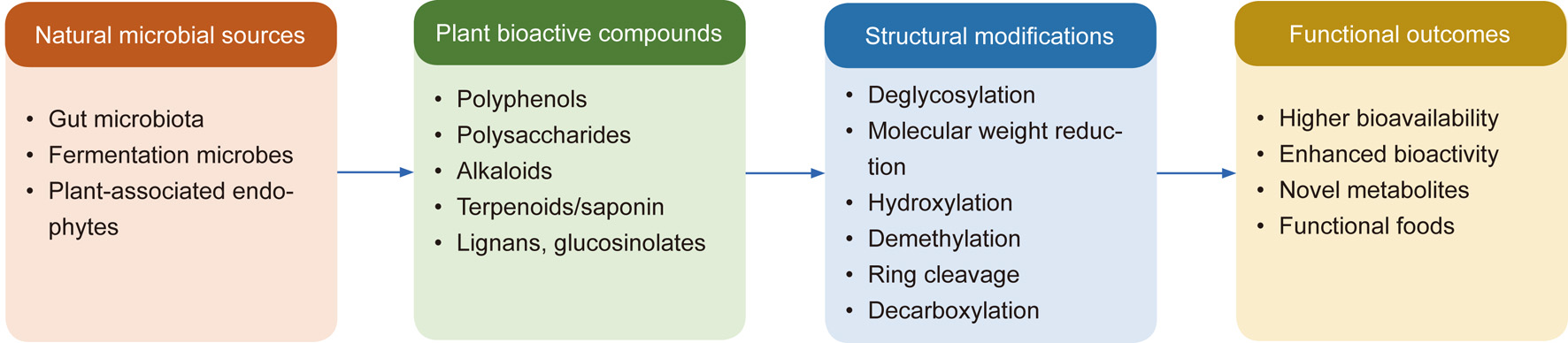 Click for large image | Figure 1. Conceptual framework of this review. |
| 2. Natural microbial sources and key biotransformation mechanisms | ▴Top |
2.1. Sources of natural microorganisms
The human colon harbours a dense and metabolically versatile microbial community capable of acting on plant compounds that escape upper gastrointestinal digestion (Ruan et al., 2020). Gut microbes including Escherichia coli, Bifidobacterium, Eubacterium, Lactobacillus, Bacteroides and Streptococcus participate in the biotransformation of natural products, generating metabolites that are often more readily absorbed and pharmacologically active than their parent compounds (Zhao et al., 2022). A second distinct group consists of the organisms deliberately employed in food processing, including lactic acid bacteria represented by Lactobacillus plantarum and L. acidophilus, yeasts, and filamentous fungi including Aspergillus niger and Rhizopus species (Li et al., 2020a; Akpoghelie et al., 2025). These are not incidental passengers but selected biocatalysts, often chosen precisely for an enzymatic profile suited to a given substrate. Lactobacillus acidophilus, for instance, grows on mono- and diglucosyl dietary plant glycosides bearing small aromatic aglycones, using phosphotransferase system transporters together with phospho-β-glucosidases to take up and deglucosylate these compounds before externalizing the resulting bioactive aglycones (Theilmann et al., 2017). The distinction between this group and gut microbiota is partly artificial, but the deliberate, controllable nature of fermentation makes it the more tractable system for food-industry application.
Endophytic fungi and rhizosphere bacteria form the third source. Having coexisted with their host plants over evolutionary time, these organisms have often evolved enzyme systems tailored to the specific phytochemicals their hosts produce (Huang and Wang, 2026). Increased understanding of the interactions between endophytic fungi and plants has led to the discovery of new chemical compounds and processes, with endophytes capable of degrading or modifying not only inorganic and organic small molecules but also a wide range of plant secondary metabolites (Aishwarya et al., 2025). One frequently cited illustration involves Fusarium sp. C39, an endophyte isolated from Dioscorea nipponica, which has been shown to biotransform the steroidal saponins of the host rhizome and increase diosgenin content through a fermentation process involving glycolytic cleavage, ring closure, dehydrogenation and carbonylation reactions (Huang et al., 2022). A 2020 analysis of patent filings identified 245 patents covering secondary-metabolite production or biotransformation applications of endophytic fungi, spanning pharmaceutical, agricultural and food uses, underscoring the scale of applied interest in this microbial source (Torres-Mendoza et al., 2020). Endophytic fungi additionally offer something the other two sources cannot easily provide: a documented capacity for genuinely novel chemistry, positioning them as promising biocatalysts for green-chemistry-oriented synthesis of new structural analogues and pharmaceutical intermediates, rather than predictable hydrolysis of existing structures (Choudhary et al., 2021).
2.2. Core enzymatic mechanisms
Despite their ecological differences, the three microbial groups described above rely on a surprisingly compact set of enzymatic tools.
Glycosidases, principally β-glucosidases and β-glucuronidases, are perhaps the most consequential of these (Stathaki et al., 2024). Most plant polyphenols, saponins and many alkaloids occur naturally as glycosides, with one or more sugar moieties attached to a lipophilic aglycone core (Bhambhani et al., 2021; El-Saadony et al., 2024; Fordos et al., 2025). The hydrolysis of these glycosidic bonds by microbial β-glucosidases and related glycosidases releases polyphenol aglycones that are more lipophilic and, in most cases, more bioactive than their glycosylated precursors, since the attached sugars otherwise hinder absorption across the gastrointestinal epithelium (Palafox-Carlos et al., 2011; Saric and Sivamani, 2016). The same logic extends well beyond polyphenols: β-glucuronidase from E. coli HGU-3 hydrolyzes baicalin to yield baicalein, while β-glucosidase produced by Eubacterium L-8 and β-glucuronidase from Streptococcus LJ-22 convert glycyrrhizin into 18β-glycyrrhetinic acid, illustrating how a single enzymatic mechanism operates across structurally unrelated compound classes (Son et al., 2021; Zhao et al., 2022; Hsu et al., 2023). Esterases and tannases perform a complementary role, releasing phenolic acids that would otherwise remain bound to cell-wall polysaccharides or esterified to other phenolics (Yang et al., 2023). Feruloyl esterases produced by Bifidobacterium animalis, Lactobacillus reuteri, L. helveticus and L. fermentum hydrolyze chlorogenic acid to liberate caffeic acid, a reaction with direct consequences for antioxidant capacity, since the freed phenolic acid is generally more reactive than its esterified form (Raimondi et al., 2015; Song and Baik, 2017; Aguirre Santos et al., 2018; Rogozinska et al., 2021; Balaj et al., 2022).
Beyond hydrolysis, oxidoreductases—including cytochrome P450 monooxygenases in fungi and various dehydrogenases in bacteria—carry out hydroxylation, dehydrogenation and ring-opening reactions that hydrolytic enzymes alone cannot achieve (Lu et al., 2019; Qin et al., 2022; Hilberath et al., 2025). For example, gradually converting the main ginsenosides into rarer forms with higher biological activity, and fungi hydroxylating the terpene skeleton at positions where it is difficult to have selective effects in chemical synthesis (Li et al., 2023a, b; Gao et al., 2024). Such microbial biotransformations, with their improved selectivity, stability and enantiomeric purity, align closely with the broader goals of green chemistry, offering an eco-friendly alternative to conventional organic synthesis for generating structurally novel molecules (Kuriata-Adamusiak et al., 2012a). In addition, a smaller but practically important set of enzymes—decarboxylases and demethylases—acts on phenolic acids and alkaloids respectively, removing carboxyl or methyl groups to alter both stability and receptor-binding behavior (Hu et al., 2020; Deng et al., 2024). Although less broadly distributed than glycosidases, these enzymes feature prominently in several of the compound-class discussions that follow, particularly where alkaloid detoxification is concerned.
| 3. Biotransformation of components | ▴Top |
3.1. Biotransformation of polyphenols
In functional food research, polyphenols are among the most extensively characterized classes of plant bioactive compounds, yet their translation from cell-culture observations to reliable in vivo effects has proved stubbornly difficult (de Araújo et al., 2021). A central reason is their uneven absorption. Only around 5–10% of ingested polyphenols are absorbed intact in the proximal gastrointestinal tract as native compounds — a narrower, absorption-site-specific metric distinct from the compound-specific relative urinary excretion range (0.3–43%) noted in the Introduction, which additionally captures metabolites generated after colonic microbial processing (Manach et al., 2005; Liu et al., 2024a). The majority of ingested polyphenol mass therefore passes into the colon, where it undergoes extensive biotransformation by resident microbiota to generate secondary metabolites that often reach substantially higher plasma concentrations and display superior pharmacokinetic profiles compared with the parent compounds (Jiang et al., 2026). From this perspective, the colon microbiota is not merely a bystander in polyphenol metabolism but the primary determinant of what ultimately reaches systemic circulation.
Among the various polyphenol subclasses, free phenolic acids such as ferulic, caffeic and gallic acid illustrate the transformation logic most directly. These compounds occur abundantly in cereals, coffee and fruits, but a substantial fraction reaches the colon in esterified or matrix-bound forms rather than as free compounds (Song et al., 2020; Wu et al., 2021). Microbial esterases and feruloyl esterases cleave these bonds, releasing the free phenolic acids that can then be absorbed or further metabolized (Oliveira et al., 2019). The hydrolysis of glycosidic bonds by β-glucosidases and related glycosidases releases polyphenol aglycones that are both more lipophilic and more bioactive than their glycosylated forms, since the attached sugar moieties restrict gastrointestinal uptake (Kroon et al., 2004; Rizzo et al., 2017; Curiel et al., 2024). Fermentation driven by microbial glycosidases, esterases and decarboxylases alters polyphenol chemical structure in ways that improve solubility, stability and antioxidant activity, and the resulting metabolites support gut health partly through promotion of beneficial bacteria such as Lactobacillus and Bifidobacterium while suppressing pathogenic species (Alharbi, 2026).
A parallel and equally well-documented pattern is seen among the flavonoids, where the conversion of glycosidic forms to bioactive aglycones is again the most consequential transformation (Ahn-Jarvis et al., 2017). Intestinal bacteria produce hydrolytic enzymes capable of hydrolyzing natural isoflavone glycosides, releasing unconjugated aglycones such as daidzein and genistein that are more estrogenic and more readily absorbed than their glycosylated precursors (Hur et al., 2000; Intharuksa et al., 2025); deglycosylation is thus a critical determinant of isoflavone absorption, metabolism and biological activity (Marín et al., 2015). Daidzein can be further reduced by anaerobic gut bacteria through a sequence involving dihydrodaidzein and tetrahydrodaidzein intermediates to yield equol, a metabolite with substantially higher affinity for estrogen receptors than any of the precursors (Muthyala et al., 2004; Soukup et al., 2021). Soy isoflavones, particularly daidzein, are metabolized by gut microbes into equol and related bioactive compounds, but only 20–35% of adults consuming a Western diet harbour the microbial consortia capable of producing these metabolites in vivo(Soukup et al., 2023; Zhuo et al., 2026). The individual differences in equol production indicate that the functional outcomes of polyphenol intake are partially dependent on the consumer’s microbiota rather than the compounds themselves. In addition, lactic acid bacteria, including Lactobacillus plantarum, Streptococcus thermophilus and Pediococcus pentosus degrade high-molecular-weight procyanidins, breaking down dimers such as procyanidin B2 and B3 while simultaneously increasing concentrations of smaller phenolic metabolites including kaempferol derivatives (Li et al., 2013; Kim et al., 2019). And the structural simplification achieved by fermentation is associated with enhanced antioxidant and probiotic potential (Wen et al., 2023).
Ellagitannins, abundant in pomegranates, walnuts, strawberries and raspberries, are minimally absorbed intact, and their bioavailability as parent compounds is very low (Tomás-Barberán et al., 2017; Zhang et al., 2023a). Specific gut bacteria including Enterocloster bolteae and Parabacteroides gordonii biotransform ellagic acid into urolithins through a sequence of reactions comprising lactone ring cleavage, decarboxylation and progressive dehydroxylation (Leng et al., 2025). The resulting urolithins are s tructurally far simpler than their ellagitannin precursors but are the compounds actually detected in plasma, establishing them as the likely effectors of the health effects attributed to ellagitannin-rich diets (García-Villalba et al., 2022). Antioxidant activity among urolithin derivatives correlates with the number of hydroxyl groups as well as molecular lipophilicity (Li et al., 2024); the most potent antioxidants are urolithins C and D, which outperform the parent ellagic acid and punicalagins in cell-based assays (Bialonska et al., 2009). The progressive dehydroxylation that occurs along the conversion pathway thus represents a structure–activity trade-off: later-stage metabolites such as urolithin A are more readily absorbed but less antioxidant than earlier intermediates, while highly hydroxylated forms are potent but remain poorly bioavailable.
3.2. Biotransformation of polysaccharides
Unlike polyphenols, plant polysaccharides are not typically thought of as compounds that need to be “activated” by microbial transformation. Their bioactivities, including immunomodulation, antioxidant properties and prebiotic effects, are generally attributed to their intact high-molecular-weight structures (Salehi and Rashidinejad, 2025; Cao et al., 2026). Yet there is growing evidence that the structural changes imposed by microbial and enzymatic processing, far from destroying these activities, can selectively amplify them, particularly in the context of gut health (Wang et al., 2019; Cao et al., 2022; Rong et al., 2026).
Microbial enzymes, including cellulases, pectinases, xylanases and amylases produced by gut bacteria and filamentous fungi, depolymerize polysaccharide chains to lower-molecular-weight fractions, with measurable consequences for bioactivity (Rowland et al., 2018; Pant et al., 2022). Enzymatic degradation of Lilium polysaccharide significantly reduced molecular weight through enzymolysis, leading to increased exposure of internal functional groups and altered monosaccharide composition; antioxidant capacity was enhanced by hydrolysis, and the degraded fractions showed distinct prebiotic profiles relative to the parent polysaccharide, tending to promote beneficial bacteria such as Megamonas, Bacteroides and Parabacteroides while the intact polymer inhibited harmful Fusobacterium (Peng et al., 2025). This molecular weight dependence on bioactivity is not uniform, however, and depends on the specific polysaccharide backbone and the assay in question. Fractionation of apple pectin-derived oligosaccharides by molecular weight revealed that the highest-molecular-weight fractions (30–100 kDa) showed superior prebiotic effects on lactobacilli, while intermediate fractions (3–10 kDa and 10–30 kDa) exerted stronger bifidogenic effects and better inhibition of pathogenic bacteria including Escherichia coli and Salmonella enteric (Wilkowska et al., 2025). Therefore, microbial depolymerization is not just about breaking down polysaccharides into smaller and more uniformly active fragments. Instead, it produces a series of products, and the individual biological activities of these products depend on their size, composition, and branching. In addition, microbial biotransformation does not affect polysaccharide molecular weight alone. It can also alter the types and proportions of constituent monosaccharides and the degree of chain branching. Fermentation by lactic acid bacteria and fungi tends to selectively cleave more accessible linkages while leaving resistant branched regions intact, producing modified structures with altered charge density, water-binding capacity and receptor interaction profiles (Wang et al., 2023a; Zhao et al., 2025). Comparison of litchi polysaccharide fractions differing in molecular weight showed that the lower-molecular-weight fraction contained relatively more neutral sugar, arabinose, galactose and rhamnose but less uronic acid; this lower-molecular-weight fraction showed higher solubility, lower viscosity, stronger stimulation of macrophage secretion of pro-inflammatory cytokines and better promotion of beneficial lactobacilli and bifidobacteria (Zou et al., 2023). Whether such structural shifts are universally associated with enhanced activity or simply reflect the liberation of previously inaccessible monosaccharide sequences remains an open question.
At the far end of microbial depolymerization, polysaccharides are broken down into oligosaccharides that selectively feed beneficial gut bacteria and into short-chain fatty acids (SCFAs) such as acetate, propionate and butyrate (Frolova et al., 2022; Wang et al., 2023b). These downstream products are responsible for some of the most documented gut health effects of dietary fiber, yet these SCFA-generating and prebiotic effects are frequently the product of microbial structural modification rather than an intrinsic property of the unmodified plant polysaccharide, since native forms often show comparatively low bioactivity prior to fermentation (Kasubuchi et al., 2015; Wang et al., 2024). The demand for natural value-added products derived from microbial biotransformation is rapidly increasing in both the food and pharmaceutical sectors, with growing scientific focus on microbial bioconversions that produce cost-effective, selective and functionally enriched compounds from natural substrates (Khosroshahi et al., 2025). The conversion of plant polysaccharides to SCFA-generating substrates by microbial fermentation thus represents one of the more direct connections between the topic of this review and functional food outcomes.
3.3. Biotransformation of alkaloids
Whereas the main problem with polyphenols is one of bioavailability, and with polysaccharides one of solubility, alkaloids are often intrinsically bioavailable but present in forms whose pharmacological profiles are shaped in unpredictable ways by first-pass intestinal metabolism (Wang et al., 2017a; Tian et al., 2018). Microbial biotransformation thus plays a dual role here: in some cases improving the efficiency and selectivity of absorption, in others detoxifying compounds whose native structures are associated with cytotoxic or adverse effects.
Among plant alkaloids, berberine has become the paradigmatic example of how gut microbiota can reshape alkaloid pharmacology. Berberine is an isoquinoline alkaloid found in several plants across genera including Berberis and Coptis, and it has documented activity against metabolic syndrome, dyslipidaemia and glucose dysregulation (Li et al., 2020b). Its oral bioavailability in native form, however, is poor (Cui et al., 2024). Higher levels of nitroreductase activity in gut microbiota increase intestinal concentrations of dihydroberberine, a reduced metabolite that is more efficiently absorbed than berberine itself (Feng et al., 2015); this microbial conversion has been associated with improved lipid metabolism outcomes in both rats and humans (Wang et al., 2017b). In addition, berberine also modulates gut microbiota composition, and the metabolic outcomes of berberine supplementation appear to depend substantially on the microbial ecosystem into which it is introduced. Key gut bacteria including Blautia species are involved in the demethylation of berberine to berberrubine and thalifendine, metabolites that may contribute to berberine’s effects on gut health alongside SCFA production (Dehau et al., 2023). Therefore, individuals whose gut microbiota are well-equipped to reduce and demethylate berberine may obtain substantially different outcomes from supplementation than those lacking these microbial capabilities.
A structurally distinct but mechanistically separate case involves caffeine and other methylxanthines, among the most widely consumed alkaloids globally (Barone and Roberts, 1996; Gramza-Michałowska et al., 2021). Systemic clearance of caffeine in humans is dominated by hepatic metabolism, with only about 0.5–3.0% of an ingested dose excreted unchanged by the kidneys; hepatic cytochrome P450 1A2 (CYP1A2) accounts for over 90% of the initial N-demethylation steps that convert caffeine to paraxanthine, theobromine and theophylline (Liu and Xu, 2026). Microbial N-demethylation of caffeine and related methylxanthines has, by contrast, been characterized primarily in environmental and food-associated microorganisms rather than in the resident human gut microbiota: soil-derived bacteria such as Pseudomonas putida CBB5 sequentially N-demethylate caffeine and theophylline via distinct but convergent pathways terminating in xanthine (Yu et al., 2009), while fungal strains isolated from fermenting Pu-erh tea, including Aspergillus sydowii, carry out analogous N-demethylation of theobromine during tea processing (Zhou et al., 2020). Whether the human gut microbiota performs a quantitatively meaningful equivalent of this reaction in vivo remains an open question.
Beyond improving the bioavailability of beneficial alkaloids, microbial biotransformation can also render toxic or irritant alkaloids safer for consumption, a function that is easy to overlook but arguably just as important from a food-safety standpoint. The steroidal glycoalkaloids α-solanine and α-chaconine, which together account for the great majority of glycoalkaloid content in potato tubers (Liu et al., 2024b). Microbial deglycosylation proceeds through sequential removal of the trisaccharide side chain, generating β- and γ-glycoalkaloid intermediates before yielding the aglycone solanidine; this stepwise loss of sugar residues alters the compounds’ interaction with cell membranes and correspondingly reduces their cytotoxicity (Wei et al., 2025). The enzymatic basis of this pathway has been resolved in some detail: bacterial isolates such as Arthrobacter sp. S41 harbour a dedicated gene cluster encoding the deglycosylating enzymes responsible for complete degradation of both compounds (Hennessy et al., n.d.), while a related enzyme portfolio comprising α-rhamnosidase (RhaA), β-glucosidase (GluA) and β-galactosidase (GalA), drawn from the GH78, GH3 and GH2 glycoside hydrolase families respectively, has been characterized in a gut-associated bacterium of the potato tuber moth and shown to carry out the same stepwise deglycosylation (Wang et al., 2022). Therefore, structural modifications do not all consistently proceed in the direction of enhancing bioactivity. In the case of steroidal glycoalkaloids, the same deglycosylation chemistry that elsewhere increases potency instead serves a protective, detoxifying function.
3.4. Biotransformation of terpenoids and saponins
Terpenoids and saponins represent one of the largest and most structurally diverse groups of plant secondary metabolites, encompassing monoterpenes, sesquiterpenes, diterpenes, triterpenes and steroidal saponins (Câmara et al., 2024). Their biotransformation by natural microorganisms has attracted considerable research interest, partly because the products of microbial transformation are often more potent or more bioavailable than the parent compounds, and partly because bacteria and fungi are capable of chemo-, regio- and stereospecific hydroxylations of complex substrates that are extremely difficult to achieve through conventional chemical synthesis (Cano-Flores et al., 2020). Cytochrome P450 monooxygenase systems in particular confer high catalytic specificity toward the hydroxylation, demethylation and deglycosylation of complex ring structures characteristic of terpenoids and steroidal alkaloids, reactions for which chemical routes generally lack comparable selectivity (Xu et al., 2026).
The ginsenosides of Panax ginseng and P. notoginseng provide the most extensively studied example of terpenoid biotransformation by food-grade microorganisms. Most ginsenosides are poorly absorbed across the human gastrointestinal tract in their native form, owing to poor intestinal permeability associated with their extensive glycosylation (Dong and Huang, 2025). Protopanaxadiol-type ginsenosides bearing multiple sugar chains, such as Rb1 and Rb2, require deglycosylation by gut or food-fermentation microbiota to generate more absorbable metabolites (Mohanan et al., 2018a; Liu et al., 2026). Microbial β-glucosidases and related hydrolases progressively remove these sugar chains to yield rare ginsenosides, including compound K, Rg3 and Rh2, whose reduced glycosylation confers greater lipophilicity, stronger membrane affinity and substantially enhanced bioactivity relative to their glycosylated precursors (Kim et al., 2022; Liu et al., 2026). Compound K was itself first characterized as a hydrolysate of ginsenosides Rb1, Rb2 and Rc generated by soil bacterial hydrolysis, and was subsequently re-identified as a product of enteric bacterial metabolism of Rb1 and Rb2 in the intestine, a discovery that established the gut microbiota as a physiologically relevant site of ginsenoside transformation (Yang et al., 2015). The directionality of conversion is determined by microbial β-glucosidase specificity: different organisms cleave sugars at distinct positions and in different sequences, meaning that the product spectrum is partly microbial-species-dependent, and that the metabolic capacity to generate compound K from Rb1 varies considerably between individuals according to their gut microbiota composition (Kim et al., 2013). Fermentation of ginseng with Aspergillus cristatus JH-5, a food-safe fungal strain with documented use in tea processing, and resulted in the de novo accumulation of rare ginsenosides Rg3(S) and Rg3(R) to a total content of 0.23% dry weight, compounds entirely undetectable in unfermented ginseng (Su et al., 2026). Rg3 and compound K carry documented antitumour, anti-inflammatory and immunomodulatory properties not shared by the major ginsenosides from which they derive, acting through pathways including PI3K/Akt signalling, caspase-mediated apoptosis and NF-κB inhibition (Yang et al., 2015; Mohanan et al., 2018b; Tang et al., 2021; Zhang et al., 2022; Lee et al., 2025b; Cui et al., 2026). And the key structural difference, reduced glycosylation of the protopanaxadiol or protopanaxatriol skeleton, is precisely the change that microbial β-glucosidases impose (Tran et al., 2023). Laboratory conversion rates reaching 98.19% for Rg3 and 95.89% for Rh2 have been reported, though improving conversion efficiency and reducing production costs remain the primary bottlenecks for industrial-scale manufacture (Xu et al., 2023).
A structurally related but botanically distinct example is found in the steroidal saponins of Dioscorea species, principally dioscin, which serve as precursors for the semi-synthesis of diosgenin, a steroidal aglycone that underpins the industrial manufacture of oral contraceptives, corticosteroids and other pharmaceutically important steroid hormones (Mandal et al., 2025; Li et al., 2026). Diosgenin is conventionally liberated from dioscin by concentrated acid hydrolysis, a process that generates substantial acidic effluent and offers only moderate yields; this has driven sustained interest in microbial and enzymatic alternatives capable of cleaving the relevant glycosidic bonds under milder, more selective conditions (Zhang et al., 2023b). Deglycosylation proceeds through sequential removal of the terminal rhamnosyl and glucosyl residues attached to the diosgenin core, a two-step mechanism resolved in molecular detail in the endophytic fungus Talaromyces stollii CLY-6, whose genome encodes a dedicated α-L-rhamnosidase that hydrolyzes the terminal rhamnoside followed by a β-D-glucosidase that releases the residual glucose units (Cheng et al., 2021). Endophytic and related fungi isolated from Dioscorea tissue have proved particularly effective biocatalysts for this transformation: Penicillium dioscin achieves diosgenin yields exceeding 90% through direct solid-state biotransformation of Dioscorea zingiberensis rhizome (Dong et al., 2015), while Fusarium sp. C39, an endophyte isolated specifically from Dioscorea nipponica, has been shown to substantially increase diosgenin content through fermentation of the host rhizome (Huang et al., 2022).
Moving from triterpenoid and steroidal saponins to the volatile terpene classes, fungal and bacterial biotransformation of monoterpene and sesquiterpene skeletons represent a category of reaction with the regio- and stereoselectivity achievable by microbial oxidoreductase systems. Stereoselective hydroxylation, epoxidation, Baeyer–Villiger oxidation, and stereo- and enantioselective reduction of ketones to secondary alcohols have been documented as a standard toolkit of green chemistry for the synthesis of chiral terpenoid derivatives not readily accessible through conventional organic synthesis (Kuriata-Adamusiak et al., 2012a). Pinene, an inexpensive and abundant monoterpene substrate, illustrates the practical scope of this approach: fungal, yeast and bacterial isolates from citrus residues have been used to convert α-pinene into verbenol, while plant cell cultures of Rauvolfia sellowii achieve enantiomerically enriched verbenone from both (–)- and (+)-α-pinene enantiomers with moderate yields (Neves et al., 2026). Within the p-menthane monoterpene series, the regio- and enantioselectivity of microbial Baeyer–Villiger oxidation has been attributed to the specific orientation of the substrate’s isopropyl group within the enzyme active site, while yeast strains such as Hormonema sp. are capable of stereoselective reduction of the carbonyl group in menthone, illustrating the fine stereochemical control achievable by whole-cell biocatalysts that has no straightforward synthetic parallel (Grabarczyk et al., 2020).
3.5. Other plant components: lignans, glucosinolates and glycosides
Plant lignans occur predominantly as glycosidic conjugates in seeds, whole grains and some vegetables, with flaxseed representing the richest single dietary source, containing lignan precursor levels 75- to 800-fold higher than any other plant food (Mareai, 2011). Their conversion to bioactive mammalian lignans requires the concerted, sequential action of several distinct gut bacterial species, each responsible for a discrete step in the pathway. After ingestion, secoisolariciresinol diglucoside (SDG) is first deglycosylated to its aglycone, secoisolariciresinol (SECO); this initial step has been attributed to strains of Bacteroides distasonis, B. fragilis, B. ovatus and Clostridium cocleatum (Clavel et al., 2006). SECO is then demethylated, a reaction catalysed by strains including Peptostreptococcus productus, Eubacterium callanderi and Eubacterium limosum (Clavel et al., 2006). Before undergoing dehydroxylation by Clostridium scindens and Eggerthella lenta to yield enterodiol, which is subsequently oxidized to enterolactone (Wang et al., 2000). Both enterodiol and enterolactone can undergo further phase I and phase II biotransformation, with extensive formation of glucuronide and sulfate conjugates prior to systemic circulation (Patel et al., 2012). The health significance of this multi-step pathway rests on the fact that it is enterolactone and enterodiol, not the parent SDG, that reach the bloodstream and exert the antioxidative, antitumour and estrogenic or anti-estrogenic activities associated with flaxseed consumption (Bowers et al., 2019). The microbial metabolic pathway from SDG through enterodiol to enterolactone is thus the route by which the health benefits of flaxseed lignan intake are actually delivered to the host (Zhu et al., 2024). The capacity to complete this multi-step conversion efficiently varies substantially between individuals according to gut microbiota composition, since the pathway depends on the co-occurrence of functionally distinct bacterial guilds rather than on any single organism.
Glucosinolates, which are present in cruciferous vegetables, mainly exist in the form of biologically inert precursors until they are hydrolyzed (Nguyen et al., 2020). Plant myrosinase ordinarily performs this hydrolysis upon cell disruption (Lv et al., 2022). However, cooking inactivates the plant enzyme, and because mammals themselves lack any endogenous myrosinase-like activity, glucosinolates that survive food processing transit to the large intestine largely intact, where their fate depends entirely on resident microbial enzymes (Marshall et al., 2023). Gut bacteria possessing myrosinase-like activity, demonstrated experimentally using germ-free and gnotobiotic animal models as well as characterized pure cultures including Lactobacillus strain LEM220, hydrolyze these intact glucosinolates to release isothiocyanates that are then absorbed across the intestinal epithelium (Narbad and Rossiter, 2018). The bioactive isothiocyanates generated through this pathway, principally sulforaphane, act through the Keap1–Nrf2 signalling axis alongside PI3K/AKT/mTOR and NF-κB pathways to activate phase II detoxification enzymes, and have documented chemopreventive properties across multiple cancer cell models (Polozsányi et al., 2024).
3.6. Cross-cutting structural patterns and their functional consequences
The compound classes reviewed above—polyphenols, polysaccharides, alkaloids, terpenoids and saponins, lignans and glucosinolates—undergo transformations that appear specific to each substrate: ring opening in flavonoids, depolymerization in polysaccharides, N-demethylation in alkaloids, sequential deglycosylation in saponins and lignans (Figure 2). Existing treatments of microbial biotransformation typically address these classes separately, either as dedicated reviews of a single compound category or as multi-class surveys organized class by class without a unifying structural framework (Mutafova et al., 2016). This section instead identifies the smaller set of structural operations that recur across classes and summarizes their functional consequences in a single comparative table (Table 1).
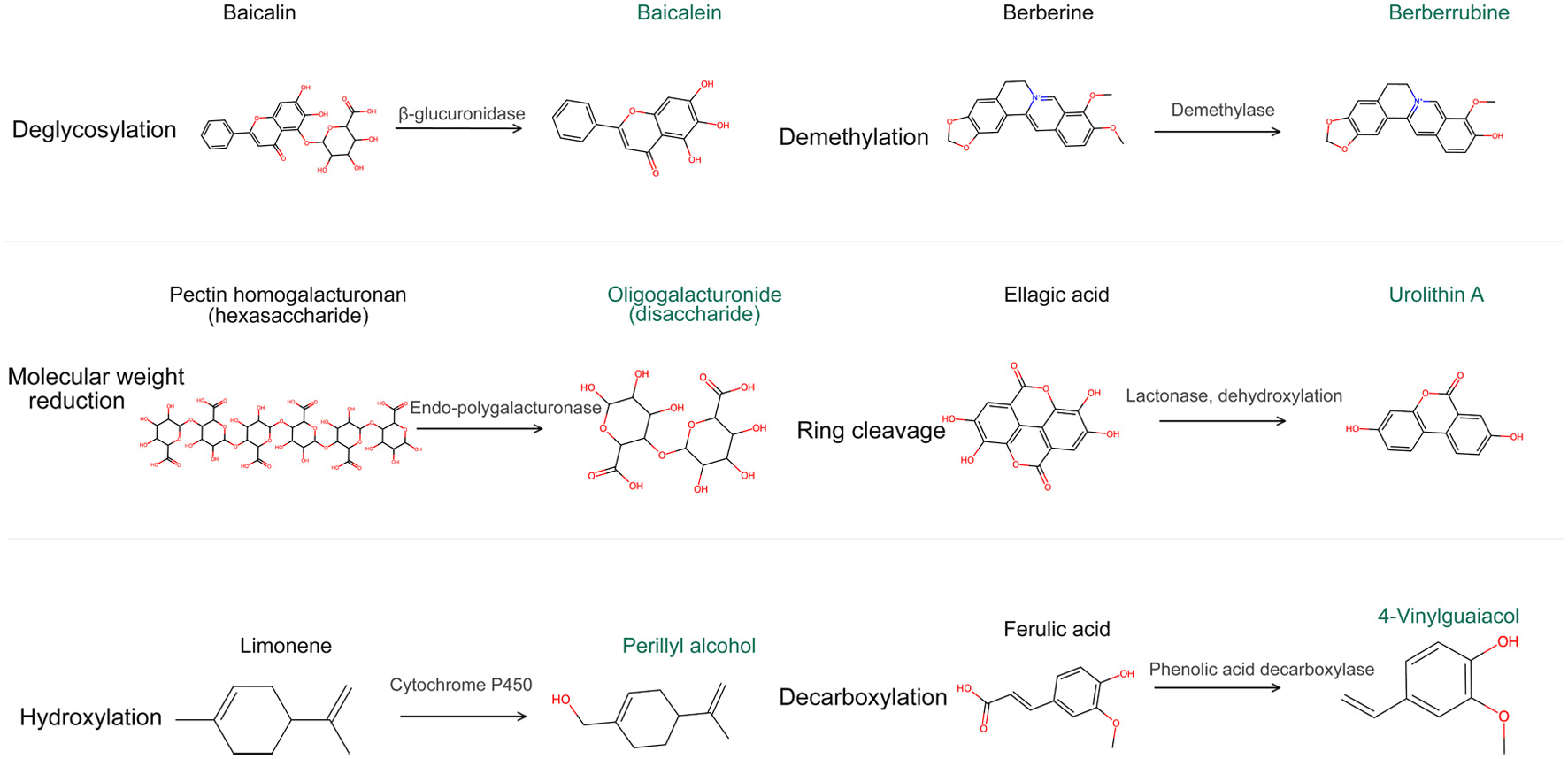 Click for large image | Figure 2. Representative examples of the major structural-modification archetypes described in this review. |
 Click to view | Table 1. Recurring structural modifications and their functional consequences across compound classes |
Removal of sugar moieties by β-glucosidases, β-glucuronidases and related glycoside hydrolases is the most broadly distributed of these operations, occurring in polyphenol glycosides, isoflavone glucosides, ginsenosides, plant lignans, glucosinolates and steroidal saponins. The resulting aglycone is consistently more lipophilic and more readily transported across intestinal epithelial membranes than its glycosylated precursor, which accounts for the frequent association between deglycosylation and improved bioavailability; the enzymes and positional specificity involved differ by substrate, and this determines whether a product simply becomes easier to absorb or acquires additional, qualitatively different activity. Molecular weight reduction plays an analogous role for polysaccharides and for condensed polyphenols such as procyanidins and tannins, where depolymerization to intermediate oligomeric fractions tends to produce material with more favorable biological properties than either the intact polymer or fully hydrolyzed monomers. Chain length therefore functions as a structural variable in its own right, separate from monomer composition. A further category involves modification of the carbon skeleton itself. Cytochrome P450-mediated hydroxylation, documented in terpenoid and phenolic acid biotransformation, alters receptor-binding geometry and metabolic stability. Bacterial demethylation, observed in alkaloids such as berberine and in lignan intermediates en route to enterolactone, removes methyl groups that would otherwise hinder receptor engagement. Ring fission, illustrated by the conversion of ellagitannins to urolithins, generates metabolites structurally unrelated to the parent compound.
A separate observation concerns the dependence of these transformations on microbiota composition rather than on the compound alone. Equol production from daidzein is limited to individuals whose gut microbiota include the requisite bacterial consortium, reported at 20–35% of adults on a Western diet (Zhuo et al., 2026). Urolithin metabotypes classify individuals by which urolithin species their microbiota generate from the same ellagitannin intake, with a subset producing none (García-Villalba et al., 2022). For example, enterolactone yield from SDG shows comparable dependence on specific bacterial taxa at each pathway step.
| 4. Applications and limitations | ▴Top |
Fermentation of plant material with defined starter cultures, rather than reliance on gut microbial action after ingestion, allows the bioactive metabolites described in this review to be generated during processing, reducing dependence on the consumer’s own microbiota. Fermentation pathways differ by microbial platform: lactic acid bacteria are the most commonly applied organisms owing to their established safety record and enzymatic capacity, while yeasts and filamentous fungi are used where more extensive restructuring of the plant matrix is required (Travičić et al., 2026). The resulting preparations, characterized as postbiotics when their activity does not depend on live cell viability, are more readily standardized and evaluated for regulatory approval than products relying on live cultures. A related strategy pairs substrate selection with the deliberate choice of microbial strain to target a specific transformation product, as in the use of Aspergillus cristatus for rare ginsenoside production or specific bacterial isolates for lignan conversion in fermented flaxseed (Zhu et al., 2024; Su et al., 2026). Demand for such targeted bioconversion products is increasing in both the food and pharmaceutical sectors (Khosroshahi et al., 2025).
Several recent examples illustrate the transition from laboratory-scale biotransformation to industrially relevant production. For rare ginsenoside compound K, an engineered Pichia pastoris strain displaying a surface-anchored Sulfolobus solfataricus β-glucosidase achieved a 93.8% bioconversion rate and a titer of 6.42 mg/mL following fermentation optimization that increased enzyme activity by 58.9% over the parent strain (Luo et al., 2026). A complementary process combining Aspergillus tubingensis fermentation with commercial cellulase reached 8.06 g/L (13.0 mM) compound K after 168 h at a productivity of 48 mg/L/h — a 2.0-fold increase in titer and 1.7-fold increase in productivity over conventional fermentation alone (Lee et al., 2025a). For ginsenosides Rh2 and Rg3, a metabolically engineered Saccharomyces cerevisiae strain carrying the full biosynthetic pathway achieved approximately 300 mg/L Rh2 in a 5-L fed-batch bioreactor (Wang et al., 2015), while a related engineered yeast platform reached 3.4 g/L of a glycosylated ginsenoside analogue in a 3-L bioreactor, though product adhesion to the bioreactor wall was identified as a specific engineering obstacle requiring further process optimization (Sun et al., 2026). For urolithin A, industrial translation has progressed furthest among the compounds discussed in this review. Amazentis’s branded ingredient Mitopure™ has been evaluated in a randomized, double-blind, placebo-controlled trial (ATLAS) in healthy, overweight, middle-aged adults, in which oral urolithin A at 500 mg or 1,000 mg daily for four months improved muscle strength, exercise performance, and biomarkers of mitochondrial health relative to placebo, providing one of the more direct examples of a microbially-derived plant metabolite advanced through controlled clinical evaluation into a defined commercial ingredient (Singh et al., 2022). In parallel, microbial fermentation routes are under active development: the strain Enterococcus faecium FUA027, isolated from human faecal samples and characterized by whole-genome sequencing, converts ellagic acid to urolithin A and has been proposed as a candidate production strain, with genomic screening confirming the absence of transmissible antibiotic-resistance genes relevant to food-safety approval (Xia et al., 2023). Ingredient suppliers including Daicel Corporation now additionally offer fermentation-derived urolithin A, indicating that chemical synthesis, engineered microbial fermentation, and screened natural isolates are being pursued commercially in parallel for the same target molecule (Sun et al., 2025).
These cases illustrate considerations that separate laboratory-scale biotransformation from industrial deployment. Engineered strains must be optimized for enzyme stability and expression level, not conversion efficiency alone. Bioreactor-scale processes must address compound-specific physical challenges such as product adhesion to reactor surfaces. Commercial translation can proceed along more than one route for the same target molecule, from clinically validated branded ingredients to fermentation-derived alternatives offered by ingredient suppliers and candidate production strains still under laboratory characterization. A full techno-economic comparison across chemical synthesis, engineered fermentation, and screened wild-type strains has not yet been published for most compounds discussed in this review and remains an important direction for future work connecting biotransformation research to food-industry application.
Several obstacles limit the scale at which these methods can be deployed. Strain stability across repeated fermentation cycles is not assured, particularly for endophytic fungi whose activity may depend on host-plant signals absent from industrial fermentation conditions. The same enzymatic selectivity that is advantageous for a purified substrate becomes a liability when applied to crude plant extracts containing multiple compound classes, since the enzyme may act on unintended substrates present in the mixture. Regulatory approval of novel fermented ingredients requires characterization of the complete product spectrum and safety evaluation of each transformation product individually, a requirement that adds cost and time to development. Finally, the interindividual variability documented throughout this review means that even a well-characterized fermented ingredient may not produce uniform effects across all consumers, since residual reliance on the consumer’s own gut microbiota is rarely eliminated entirely.
Funding
This work was supported by the Guangdong-Macao Science and Technology Innovation Joint Research Special Fund (2023A0505020013, 2025A0505010005); Macau Science and Technology Development Fund (0104/2024/AGJ);Guangdong Provincial Observation and Research Station for Coupled Human and Natural Systems in Land-ocean Interaction Zone (2024B1212040003).
| References | ▴Top |